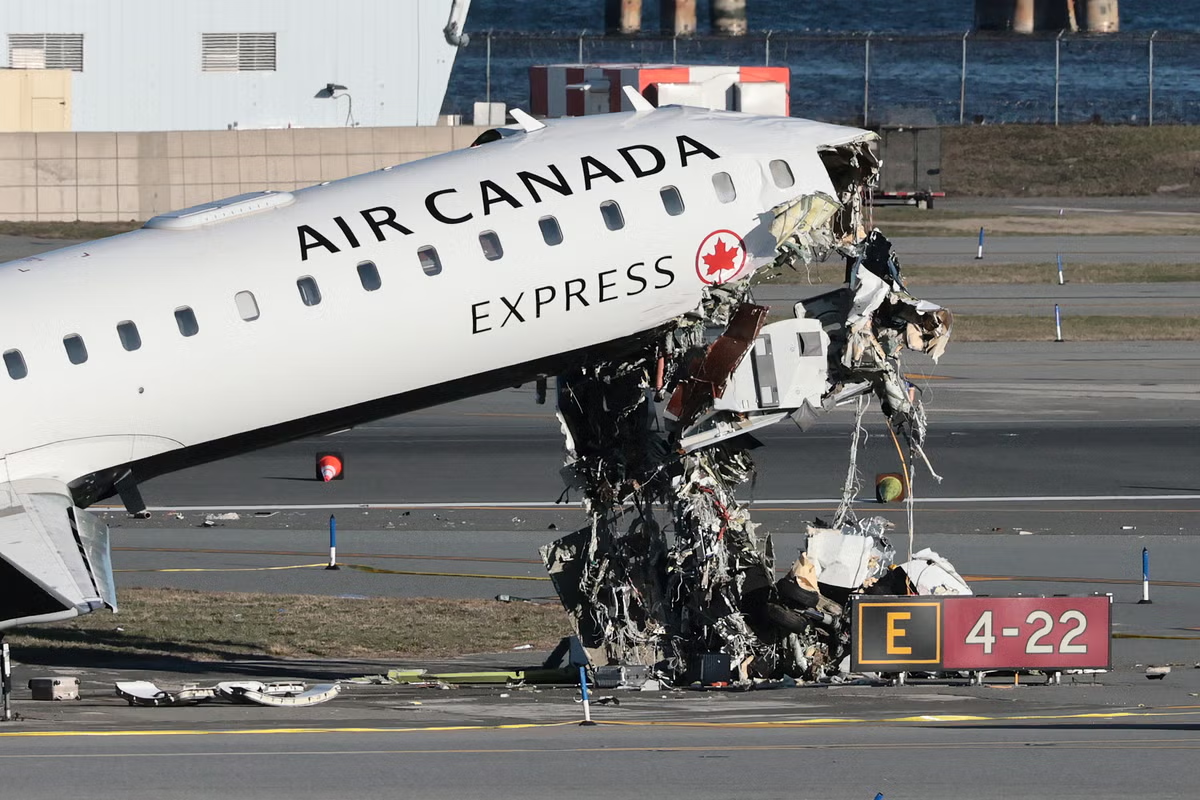
The recent rash of deadly accidents and close calls at U.S. airports already struggling with an air traffic controller shortage and hundreds of federal layoffs has many travelers — and even some folks on the ground — worried about the next disaster.
While public awareness of even minor mishaps involving airplanes has never been greater, aviation experts tell The Independent that air travel is the still the statistically safest form of transportation.
But they also warn that there’s a flaw in high-tech safety systems used at airfields across the country — one that may have fueled the devastating runway collision that killed two pilots at New York City’s LaGuardia Airport in March.
“It’s an existing gap, and it needs to be closed,” said retired airline captain-turned-safety consultant John Cox, who’s testified before Congress and the National Transportation Safety Board.
The issue involves relatively inexpensive electronic transponders that let air traffic controllers track the movement of vehicles on the ground, which the Federal Aviation Administration has urged airports to adopt since 2011, but has never made mandatory.
In addition to the LaGuardia collision, the spate of incidents includes the harrowing, caught-on-camera moment when a plane carrying 231 passengers and crew clipped a light pole and bread truck on the New Jersey Turnpike while approaching Newark Airport.
The truck driver, Donald Boardly Jr. of Baltimore, miraculously survived with minor injuries after the Boeing 767’s landing gear apparently smashed into the cab of the bakery delivery truck he was driving on May 3. “He described total fear that he wouldn’t walk away from it,” his father, Donald Boardly Sr., later told reporters, according to nj.com. “He thought he’d be decapitated.”
Retired United Airlines captain Steve Arroyo, who was based in Newark and used the same route to safely land there “dozens of times” during his careers, said the plane was obviously “below the glide path” for a landing with “narrow margins” for safety.
“They came within inches of a major catastrophe,” he said.
The next day, a regional flight from Rochester, New York, came within 500 feet of a single-engine propeller plane flying overhead as they crossed paths while landing at New York City’s Kennedy Airport, according to local TV station WABC.
That near miss came just two weeks after an April 20 incident at Kennedy during which cockpit alarms sounded when a plane that was attempting to land missed its approach and veered into the path of another that was forced to abort its landing and climb 3,000 feet to avoid a midair collision.
And that followed a similar incident two days earlier at Tennessee’s Nashville Airport, as well as a March 24 close call involving a military Black Hawk helicopter and a Boeing 737 at John Wayne Airport in Santa Ana, California, that evoked memories of the 67 people killed last year when a Black Hawk and a regional jet collided over the Potomac River in Washington, D.C., near Reagan Airport.
More recently, a grisly accident took place at Denver Airport, where a suicidal man climbed over a fence and walked onto a runway where he was fatally sucked into a plane’s engine as it was attempting to take off on May 8, igniting a fire and causing minor injuries to 12 people on board.
The most recent commercial aviation statistics released by the NTSB show that accidents in the U.S. during 2008-2024 ranged from a high of 91 in 2008 to a low of 59 in 2020, when airline traffic declined dramatically due to the COVID-19 pandemic.
In 2024, there were 75 commercial aviation accidents in the U.S., including 34 that involved major airlines, regional carriers and cargo operators, with the latter number up from 32 in 2023. None of those accidents caused any deaths, according the the NTSB.
There were also 41 accidents in 2024 involving smaller, on-demand charter operators and commuter aircraft, including six that killed people, up from 36 accidents in 2023, when there were eight deadly accidents.
The independent Flight Safety Foundation’s Aviation Safety Network, whose tallies differ from the NTSB’s, counted 61 commercial aviation accidents in the U.S. last year, up from 54 in 2024, according to figures posted on the network’s online Global Accident Dashboard.
John Cox said the recent increases didn’t mean the public faced any greater risks because “if you look at the total number of accidents over a five- or 10-year period, the trend line continues to come down.”
“I look at the data daily and I have not seen an erosion in safety,” he said. “The most dangerous part of any flight is the drive to and from the airport — and that is an absolute fact.”
Arroyo likewise said that “when you look at the statistics, 75 to 85 million people fly every month in the USA.”
“A passenger would have to fly 20 million flights to be involved in an accident,” he said. “I feel confident that our air transportation system here in the United States and globally is very safe, notwithstanding those anomalies we’ve seen in the past weeks and months.”
Cox, who serves as an aviation analyst for NBC News, also said that because airline travel is so safe, even near misses can be turned into news.
“I watch the media and see how they have increased their interest in any deviations in aviation safety,” he said. “When you get any deviation, it stands out from the roughly 40 million flights that year.”
A spokesperson for the Flightradar24 website, which tracks air traffic using a global network of 50,000-plus ground receivers, also said technological advances had made it much easier for reporters and the public to learn about accidents and close calls in real time.
“With advent of software to find radios and the ability of a lot of people to build a receiver, that makes these types of incidents more visible,” spokesperson Ian Petchenik said. “Whereas, a few years ago only a few folks who were interested would know.”