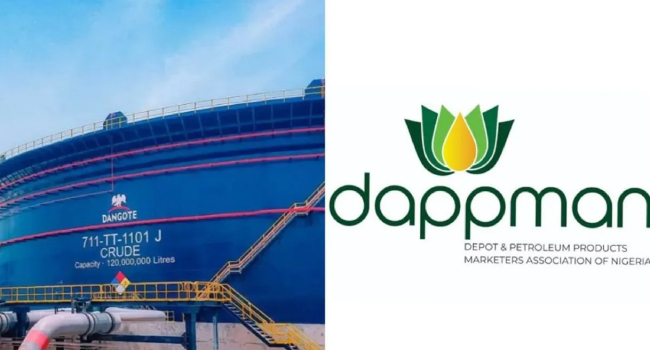
Declare fresh lawsuit by Africa’s richest man against Nigerian fuel consumers
Insist petroleum products market not a monopoly
Emmanuel Addeh in Abuja
The Depot and Petroleum Products Marketers Association of Nigeria (DAPPMAN) yesterday pushed back against the fresh lawsuit filed by the Dangote Petroleum Refinery seeking to invalidate fuel import licences issued by the Nigerian Midstream and Downstream Petroleum Regulatory Authority (NMDPRA).
In a strongly-worded statement, the association argued that the licences being challenged were not mere administrative favours, but legal instruments issued under the Petroleum Industry Act (PIA) to guarantee the country’s fuel supply security.
THISDAY recently reported that the midstream and downstream regulator had again issued import licences to some Nigerian oil marketers to bring in over 600,000 metric tonnes of petrol into the country.
The latest dispute is the newest chapter in the growing battle over fuel importation and market control in Nigeria’s downstream petroleum sector following the commencement of operations at the Dangote Petroleum Refinery.
Since the 650,000 barrels-per-day refinery began supplying petroleum products to the local market, Dangote has repeatedly argued that continued issuance of fuel import licences to marketers undermines domestic refining, weakens investment incentives and encourages dependence on imported products despite existing local capacity.
Before now, the refinery had challenged the NMDPRA in court over the issuance of the permits to several marketers, insisting that such approvals contravened the spirit of the PIA, which encourages local refining and permits imports only in cases of supply shortfalls. It later withdrew the case from the court.
However, marketers and industry operators have countered that the PIA empowers the regulator to issue import licences whenever necessary to guarantee energy security, market competition and uninterrupted supply of petroleum products across the country.
In its statement, DAPPMAN maintained that the NMDPRA acted within its statutory powers in approving the licences, stressing that the regulator’s responsibility was to ensure uninterrupted product availability for Nigerian consumers and not to protect the commercial interests of any single refinery, regardless of its size.
The association stated that its members had invested billions of naira in petroleum depots, logistics systems and compliance infrastructure based on the understanding that the licences granted to them were lawful, valid and protected under the law.
According to the marketers, any attempt to retroactively void those approvals would create uncertainty across the downstream petroleum sector at a time when stability in fuel supply remains critical.
“The news that Dangote Petroleum Refinery has filed a fresh lawsuit seeking to set aside fuel import licences issued by the NMDPRA to marketers and the NNPC demands a clear response from this association.
“The import licences at the centre of this lawsuit are not administrative courtesies. They are the legal instruments through which Nigeria’s fuel supply chain functions. They were issued under a regulatory framework established by the Petroleum Industry Act, by an authority empowered to make exactly this kind of determination. The NMDPRA has consistently maintained, correctly, that these licences exist to protect supply security, not to disadvantage any single producer, however large.
“DAPPMAN’s member companies have invested billions of naira in depot infrastructure, logistics networks, and compliance systems on the basis that their operating licences are valid, lawful, and durable. A legal action designed to retroactively void those licences does not just affect individual businesses, it introduces uncertainty into the entire downstream supply chain at a moment when Nigeria can least afford it,” the association maintained.
It added that the NMDPRA had consistently defended the issuance of import permits as necessary tools for safeguarding national supply, insisting that the position had previously been upheld in court and should continue to stand.
While acknowledging Dangote Refinery’s right to seek legal redress, DAPPMAN rejected what it described as the underlying argument that a private refinery’s commercial interests should supersede the statutory mandate of the regulator.
DAPPMAN further warned against any attempt to turn Nigeria’s downstream petroleum industry into a monopoly, arguing that the market had evolved over many years into a multi-player system serving millions of Nigerians daily.
The association disclosed that it would engage legal counsel, work with affected member companies and make formal representations to the relevant authorities over the matter.
“We respect Dangote Petroleum Refinery’s right to pursue legal remedies. What we do not accept is the premise that a private refinery’s commercial interests should override a regulatory authority’s mandate to ensure adequate supply to Nigerian consumers.
“The PIA is clear: import licences may be issued where the regulator determines it necessary. That determination has been made. It has been defended in court before. It should be defended again.
“Nigeria’s fuel market is not a monopoly waiting to happen. It is a competitive, multi-participant market that has taken years to build and that serves millions of Nigerians every day. DAPPMAN will be engaging legal counsel, coordinating with affected member companies, and making formal representations to the relevant authorities on this matter,” the statement added.
The group argued that the strength of Nigeria’s downstream sector lies in the participation of multiple operators, warning that efforts aimed at shrinking the number of market participants would ultimately hurt consumers through reduced competition and supply vulnerabilities.
According to DAPPMAN, “A lawsuit that seeks to reduce that field of players is ultimately a lawsuit against Nigerian consumers,” adding “Our members did not build this industry to watch it be argued out of existence in a courtroom.”
Rather, the group argued that its members built those facilities to serve Nigeria, emphasising that that is what they will continue to do, and pointing out that DAPPMAN will stand behind every one of them through the process.