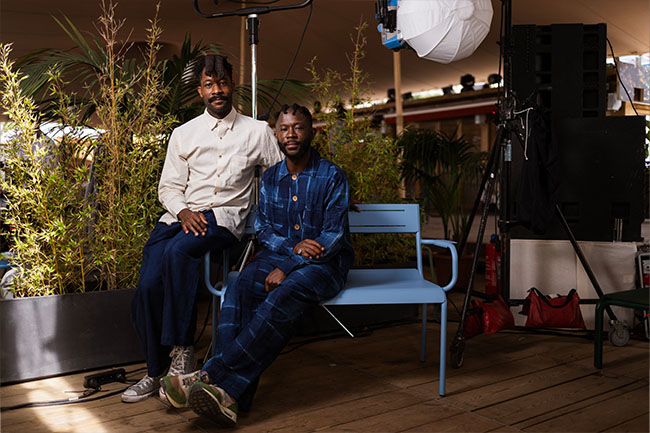
The 79th annual Cannes Film Festival has found its most glittering, yet unsettling, breakout hit in Clarissa. Directed by twin brothers Arie and Chuko Esiri, the film transplants Virginia Woolf’s 1925 novel Mrs Dalloway from post-war London to the waterside mansions of Lagos.
Shot on 35mm film rather than digital cameras, Clarissa unfolds over a single evening as an elegant high-society matriarch, played by Sophie Okonedo, prepares to host a lavish party. Yet, beneath the champagne flutes and perfect tailoring of the elite bubble, lies a society fracturing under the weight of immense economic disparity.
The Esiri brothers, who won global acclaim for their 2020 migration drama Eyimofe, map out the subtle snobberies of a class completely detached from the daily struggles of the megacity surrounding them. In an elegant piece of visual symbolism, the film features a wonky mosaic in the shape of Nigeria that the wealthy hosts cannot seem to hang straight.
“It’s a perfect motif of the nation,” screenwriter Chuko Esiri remarked at the festival. “It’s slightly off and needs correcting… but no one quite knows how.”
The film cuts between the affluent world of the elite and the harrowing reality of Septimus (Fortune Nwafor), a young soldier returning from the frontlines of the insurgency in Northern Nigeria. Suffering from severe PTSD, Septimus’s life intersects with Clarissa’s through his wife, who works as her dressmaker.
Because this motion picture relies heavily on the emotional weight of memories, the filmmakers faced the unique challenge of casting each prominent character twice—matching their younger selves in 30-year-old flashbacks with their present-day counterparts in contemporary Lagos.
Guided by casting director Nina Gold, the production seamlessly paired its ensemble, creating an intentional bridge across different generations of the West African diaspora:
Clarissa: Rising star India Amarteifio (Queen Charlotte: A Bridgerton Story) plays the delicate, complex younger Clarissa, setting up the elegant matriarch later portrayed by Sophie Okonedo.
Sally: Emmy-winner Ayo Edebiri (The Bear) plays a younger Sally, whose older self is portrayed by Nikki Amuka-Bird.
Peter: Toheeb Jimoh (Ted Lasso) portrays the handsome younger Peter, capturing a passionate affair that shadows the character’s older, more worldly life.
Hollywood mainstay David Oyelowo anchors the present-day elite high-society circle, bringing immediate gravity to the film’s social playground.
Behind the Scenes
The magic of Clarissa, which secured global distribution with indie label NEON, lies in how Sophie Okonedo’s entirely instinctual performance perfectly meshes with the precise framework created by the Esiri brothers.
For Okonedo, connecting with the character did not require overthinking. It was an immediate reaction to her own stage of life and a profound gut instinct:
“I don’t worry about trying to get it out there. I leave that for you to pick up… I mean, I just felt like, just the age I am, that I really could play this part because I’m this age, and these are my thoughts, feelings, fears, and reflections on my life looking back. And I’ve experienced longing.”
Okonedo actually committed to the project before a single page was finalised, purely because of her faith in the directors. “I’d watched their first film and it’s so amazing that I just said, ‘Yeah, I really want to meet.’ And then they said, ‘You talked about you wanted to do an adaptation of this.’ And I was like, ‘I’m in. Don’t even need to read it.’”
David Oyelowo was similarly drawn to the project, noting how the script offered a rare, meditative space that is completely missing from contemporary, algorithmically-driven streaming content:
“There was a lot of breath in the script… everything be about the notions of loss and regret, and what could have been, and what is not, and what is. And these are all incredibly nebulous things. It’s sort of like trying to grasp air, but felt so relatable on the page… You very rarely get afforded that opportunity now in a world of streaming movies that are algorithmically driven, that are changing our brain chemistry as it pertains to film. So now, when you see something that is taking that amount of time, it’s like an event, actually.”
This deliberate pacing is rooted in how Chuko and Arie divide their responsibilities. Chuko builds tight, unshakeable narratives on the page. “My strength lies in the writing,” Chuko explains. “I spend a lot of time working very hard to make it fluid… on the page. I don’t want to find ourselves in a situation where it’s like, ‘Oh, you know, in the edit we’ll find it.’” Arie balances this rigidity by tracking the film’s emotional heartbeat on set, ensuring there is space for the actors to let their unspoken longing truly resonate.
The cast and crew of ‘Clarissa’ take in the huge round of applause after tonight’s screening in #Cannes pic.twitter.com/coF3AJfuJ8
— Deadline (@DEADLINE) May 16, 2026
Crossover, Global Representation
By blending Hollywood names with legendary Nollywood stars (such as Joke Silva, Ego Boyo, and Nobert Young), Clarissa marks a major turning point for how African stories are told and marketed globally.
Historically, diaspora actors of Nigerian heritage often build massive careers in Hollywood or the UK without ever connecting back to indigenous African productions. Clarissa unifies the “Naija” identity across continents under one cohesive banner, proving that African storytelling does not have to choose between being culturally authentic or internationally marketable.
The set itself became a deeply moving homecoming for the cast, many of whom had never filmed in Nigeria before. As Oyelowo reflected, because of the historical tokenism within the UK film industry, Black actors were rarely cast in the same project.
“It was deeply emotional for us as actors all of African descent in some way… We’re all have a connection to West Africa and sometimes Nigeria specifically, but none of us to my knowledge had actually worked in Nigeria… So this feeling of homecoming and nostalgia was also really palpable for us. And so again, all of that worked its way into the film.”
For decades, western festivals have often box African cinema into cliche lanes focused strictly on poverty or trauma. With Clarissa, these diaspora stars are given the space to play characters grappling with classic, existential human dilemmas—longing, missed possibilities, class insulation, and regret. Using a high-profile cast to adapt a western literary masterpiece completely reframes what an “African story” can look like on the world stage.
Securing actors with massive Western fanbases and critical acclaim is precisely what opens doors, allowing a beautifully shot, independent film with a $5 million budget to capture the attention of global distributors like NEON.