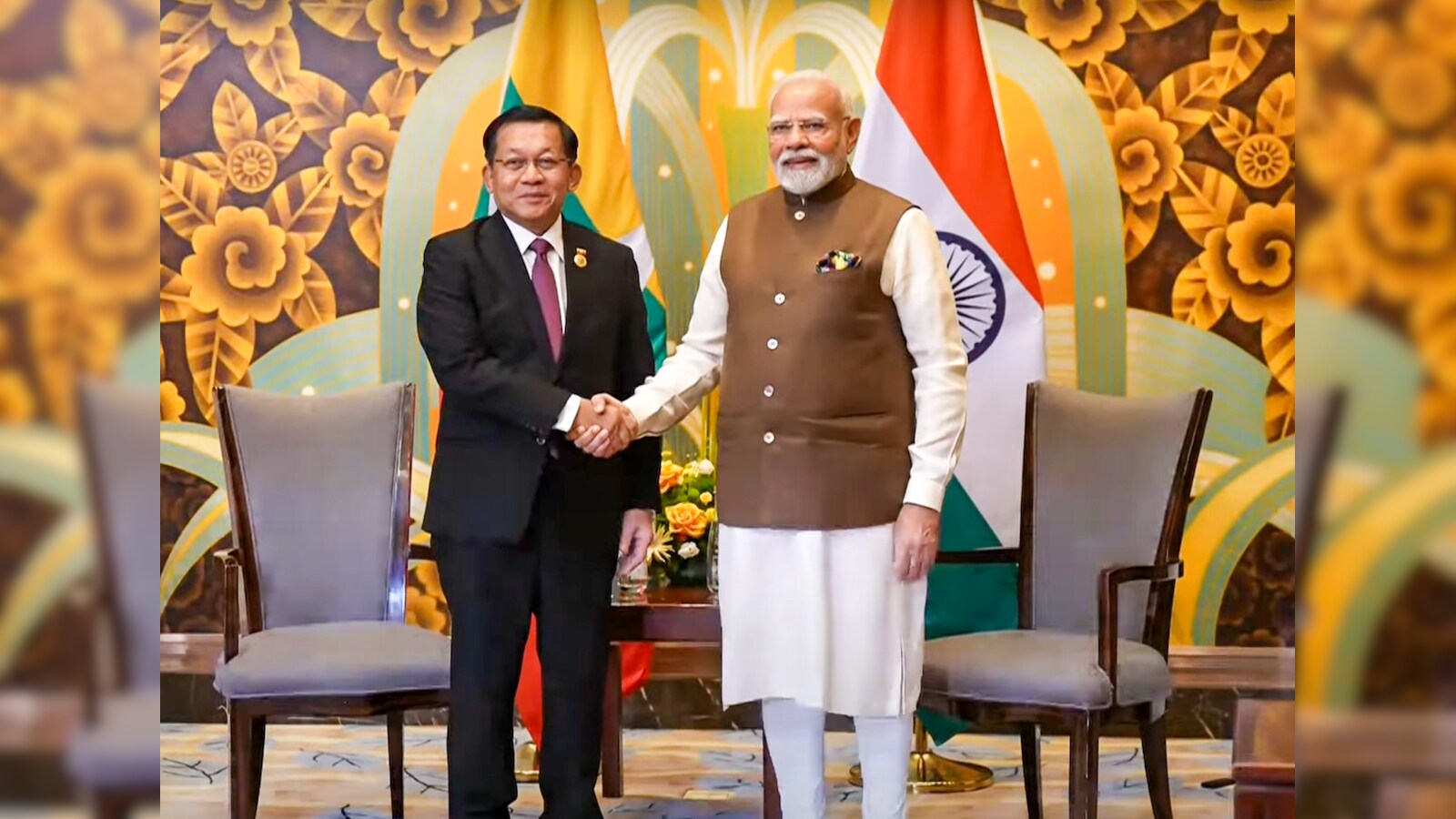
Myanmar’s President Min Aung Hlaing will arrive in India for a high-profile bilateral visit to India with a high-level delegation comprising several cabinet ministers and business leaders from his country. India and Myanmar share a 1,643-kilometre-long international boundary that spans across four states, including Arunachal Pradesh (520 km), Mizoram (510 km), Manipur (398 km), and Nagaland (215 km).
Initially scheduled to visit India to participate in the International Big Cat Alliance Summit on 1 June (since deferred), Min Aung Hlaing will now pay an official visit to India from 30 May to 03 June 2026 at the invitation of Prime Minister Narendra Modi.
Experts say the visit is critical for a number of reasons. Not only does it have a symbolic cultural importance, especially with the visit starting from Bodh Gaya, but also key business ties and border-related issues are likely to be on the agenda as well. Among the key bilateral issues is the strategically important Kaladan Multi-Modal Transit Transport Project, which the government had hoped to complete by 2027.
Dr Cchavi Vasisht, an associate fellow at the Centre for Geopolitics and Strategic Studies at the Chintan Research Foundation, told NDTV, “This is not merely accidental or strategic, as many analysts would be tempted to read into it as a pivot, i.e., Myanmar’s president is choosing India over China. The more accurate and policy-relevant framing to this is that Min Aung Hlaing is not choosing India over China but choosing both simultaneously and deliberately.”
The China-India Binary
As with Bangladesh and Nepal, India’s bilateral ties with neighbours on the eastern front are often seen through the India-China prism. But those watching the India-Myanmar ties closely say this is a mistake, especially when it comes to a complex relationship with Myanmar, where the internal dynamics have also remained fragile given the ethnic conflict, military coup and armed resistance in the country. The active EAOs (Ethnic Armed Organisations) in border areas add another layer to this complex bilateral relationship.
India’s engagement with Myanmar since the April 2026 transition has been active, consistent, and deliberately grounded. Even post the 2021 military coup, India sustained engagement with Myanmar’s military authorities, keeping in mind that disengagement would not advance democracy in Myanmar but would affect Indian interests in border security and connectivity and certainly isolate Myanmar and push it towards China’s embrace.
“For India, it will continue calibrated engagement and maintain institutional ties and invest in presence across all likely political scenarios. And for balancing interests in Rakhine/Chin, India has adopted a dual-track policy of maintaining ties. So, India continues to maintain development and humanitarian presence and keeps channels open to all of Myanmar’s significant political actors: the new government, the Arakan Army, the KIO, the NUG, and the ethnic civil society networks,” Dr Chhavi Vasisht told NDTV.
“For Myanmar, the visit is best understood as opening additional lanes of diplomatic and economic breathing room with New Delhi but not the loosening of the China anchor. Though in some ways also indicating that there is a preference for diversity and the possibility that this may also be seen as signalling to the West, particularly the USA, that Myanmar is keen to find a pragmatic way to reduce dependence on China,” Dr Vasisht adds.
Border Management: A Key Bilateral Issue
Historically, the India-Myanmar border was governed by the Free Movement Regime (FMR), which allowed visa-free travel for residents within 16 km of the border, has now been restricted, with visa-free movement to be limited to just 10 kilometres, alongside increasing requirements for biometric-enabled entry and exit gates and a massive border fencing exercise.
Dr Vasisht, who has co-edited a book titled “Revisiting Myanmar” along with Brigadier Vinod Anand, told NDTV, “I believe that the most urgent bilateral issue is the management of a 1,643-kilometre border. The NIA’s arrest in March 2026 of six Ukrainian nationals and one American, allegedly for training Chins and transiting drone consignments through Mizoram, confirmed that Myanmar’s civil war is generating foreign fighter networks that use Indian territory as a transit corridor. The earlier discussions during the Navy Chief’s visit focused on enhancing regional stability and on Myanmar’s stated desire for cooperation to prevent the presence of armed groups along the India-Myanmar border.”
“The presidential meetings will almost certainly advance this agenda. Even though India is aware that these areas are not fully under the control of the present government, India will likely seek stronger commitments on VBIG sanctuaries, intelligence sharing on cross-border drone and arms movements, and possibly a formal border management mechanism for the Mizoram and Manipur sectors,” Dr Vasisht added.
The Important Kaladan Corridor
The Kaladan Multimodal Transit Transport Project (KMTTP) is the result of the India-Myanmar Friendship Treaty. This is a strategic initiative to enhance connectivity between India’s Northeast and Myanmar – with an aim to make it fully operational within the next few years.
Empowered by the transformative ‘Act East’ policy, this once landlocked region is now poised for direct and shorter access to international sea routes. The swift execution of the Sittwe Port in Myanmar is a testament to this commitment. Once fully operational, the region will unlock new trade opportunities not just for Northeast India, but also for Bangladesh, Bhutan, Nepal, and Myanmar by connecting them with Southeast Asia. The government says this project is the result of the guiding philosophy of ‘Sabka Saath, Sabka Vikas’ – collective effort for inclusive growth.”
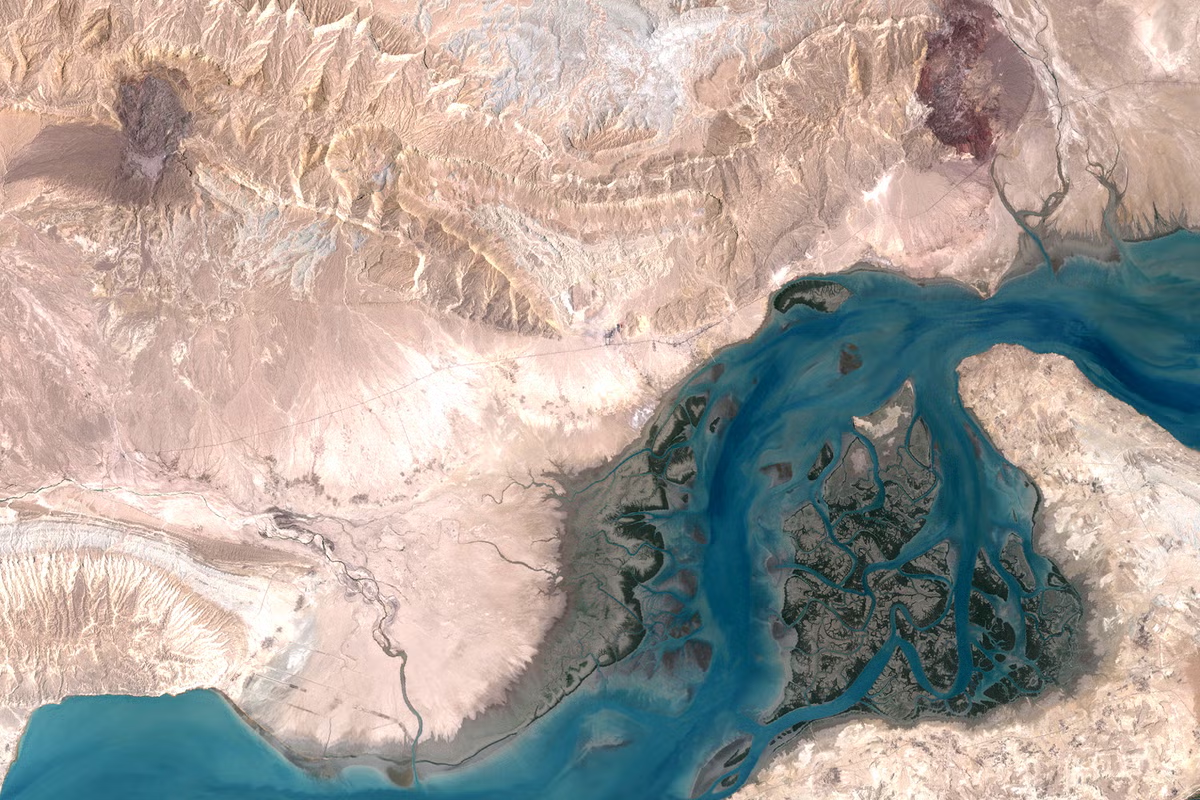
The project consists of a corridor from Paletwa in Myanmar to Zorinpui in Mizoram, the Sittwe port connects to Paletwa in Myanmar through an inland waterway and from Paletwa to Zorinpui in Mizoram through a road component. Even though the project runs through areas of Myanmar that are not in control of the Junta, India is going to seek guarantees from Myanmar.
“We cannot expect the Kaladan Multi-Modal Transit Transport Project to receive the push as it runs through Arakan Army-controlled territory. Sittwe Port, operated by Indian Ports Global Limited, is now functioning as the primary goods gateway into Rakhine State precisely because the Arakan Army has maintained operational stability in its administrative territory. What can be expected is some form of assurance from Naypyidaw that military operations will not disrupt port access,” Dr Vasisht explains.
From Military Chief To President – Legitimacy And Leadership
The former Myanmar Junta chief Min Aung Hlaing was elected president in April this year after breezing through a parliamentary election in the country. The transition from a military to civilian ruler not only formalises his grip on political power in Myanmar, but also gives him a degree of legitimacy despite the questions raised by the West on the validity of the election.
Hlaing has ruled the civil war-torn nation for five years after he ousted an elected government in a coup. Hlaing toppled the administration of Nobel Peace Prize winner Aung San Suu Kyi in 2021 and put her under arrest. In May this year, Aung San Suu Kyi was moved from prison to house arrest after her sentence was reduced as part of a prisoner amnesty for a Buddhist holiday.
Explaining Min Aung Hlaing’s recent transition from military ruler to civilian president, Dr Vasisht says, “Certainly, there has been a political transition, though not inclusive; the current civilian government holds the power. Therefore, India has maintained pragmatic engagement with the government. With EAOs, as stated above, India continues to engage and provide humanitarian assistance. And it is expected that during the visit, the Indian side would push for serious inclusive dialogue between all stakeholders.”
What Could Be The Possible Outcomes?
As the MEA official statement has said, the visit is for further strengthening the historical and civilisational ties between the two countries. Therefore, the visit is starting from Bodh Gaya, which is symbolic as Myanmar maintains deep Theravada Buddhist traditions, and a visible pilgrimage can resonate domestically, even though there has been bombing over monasteries in the past few years.
“Bilateral trade reached about $2.1 billion in 2024-25, with India importing pulses from Myanmar, making India the fourth-largest trading partner of the country. The extension of the black gram and pigeon pea MoU at the inauguration locked in the pulse trade framework until 2030-31. So new sectors such as pharmaceutical exports, agricultural machinery, and energy cooperation, including solar technology, are also on the table. The visit may have announcements on expanding the rupee-kyat settlement mechanism, which has been operational since January 2024, reducing dollar exposure for both sides,” Dr Cchavi Vasisht points out what India’s likely focus areas could be when it comes to India-Myanmar ties.
“Myanmar lies at the confluence of India’s Neighbourhood First, Act East and MAHASAGAR policies. The official visit of President U Min Aung Hlaing to India is expected to further strengthen and deepen the multi-faceted relations between the two countries,” a statement from the Ministry of External Affairs said.