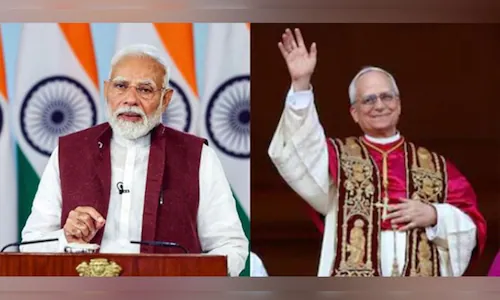
The report, titled “AI for Humanity: Pope Leo XIV and Prime Minister Modi’s Shared Vision”, examines the Pope’s recent encyclical Magnifica Humanitas: On Safeguarding the Human Person in the Time of Artificial Intelligence alongside multiple speeches and public remarks by Modi on AI policy and governance.
According to the report, both leaders strongly emphasise that AI must remain human-centric and should serve humanity rather than replace or dominate it.
“In the era of artificial intelligence, when human dignity is threatened by new forms of dehumanization, ours is the pressing duty to remain profoundly human,” Pope Leo XIV wrote in the encyclical.
The report compared this with Modi’s remarks at the India AI Impact Summit 2026, where he said: “Technology exists to serve humanity, not replace it.”
Shared concerns over dehumanisation and inequality
The report argues that both leaders view AI not merely as a technological or commercial tool, but as a moral and societal challenge that must be guided by ethics, inclusion and public welfare.
It noted that both Pope Leo XIV and Modi warn that AI could deepen inequality if access to data, computing power and technological decision-making remains concentrated in the hands of a few countries or corporations.
The report also highlighted similarities in their concerns about dehumanisation and misuse of AI systems.
The Pope warned against reducing “the mystery of the person” into “data and performance”, while Modi has cautioned that AI “must not reduce human beings to mere data points or raw material”.
Both leaders also stress that AI systems can inherit and amplify social biases if datasets are not inclusive and carefully designed.
Focus on jobs, ethics and global cooperation
The report found common ground on the future of work as well, with both leaders acknowledging that AI-driven automation could disrupt employment and social stability.
While the Pope called for safeguards, retraining and worker participation during technological transitions, Modi has repeatedly argued that skilling and preparation are essential to adapting to AI-led change.
The report also pointed to similarities in their calls for international cooperation on AI governance.
It noted that Pope Leo XIV has warned against allowing “a handful of actors” to dominate AI development, while Modi has advocated for a global framework built around ethical safeguards, accountability and transparency.
The report highlighted Modi’s proposed “MANAV” framework for AI governance, which focuses on moral systems, accountable governance, national sovereignty, accessibility and legitimacy.
India’s AI vision increasingly framed around ethics
The report comes at a time when India is seeking a larger role in shaping global AI governance and positioning itself as a major AI and digital economy hub.
Over the past few years, Modi has increasingly framed India’s AI strategy around inclusivity, public welfare and the needs of the Global South.
The report concludes that both Pope Leo XIV and Modi reject the idea of AI as an instrument of domination or exclusion and instead advocate a model of AI that is ethical, welfare-oriented and centred on human dignity.