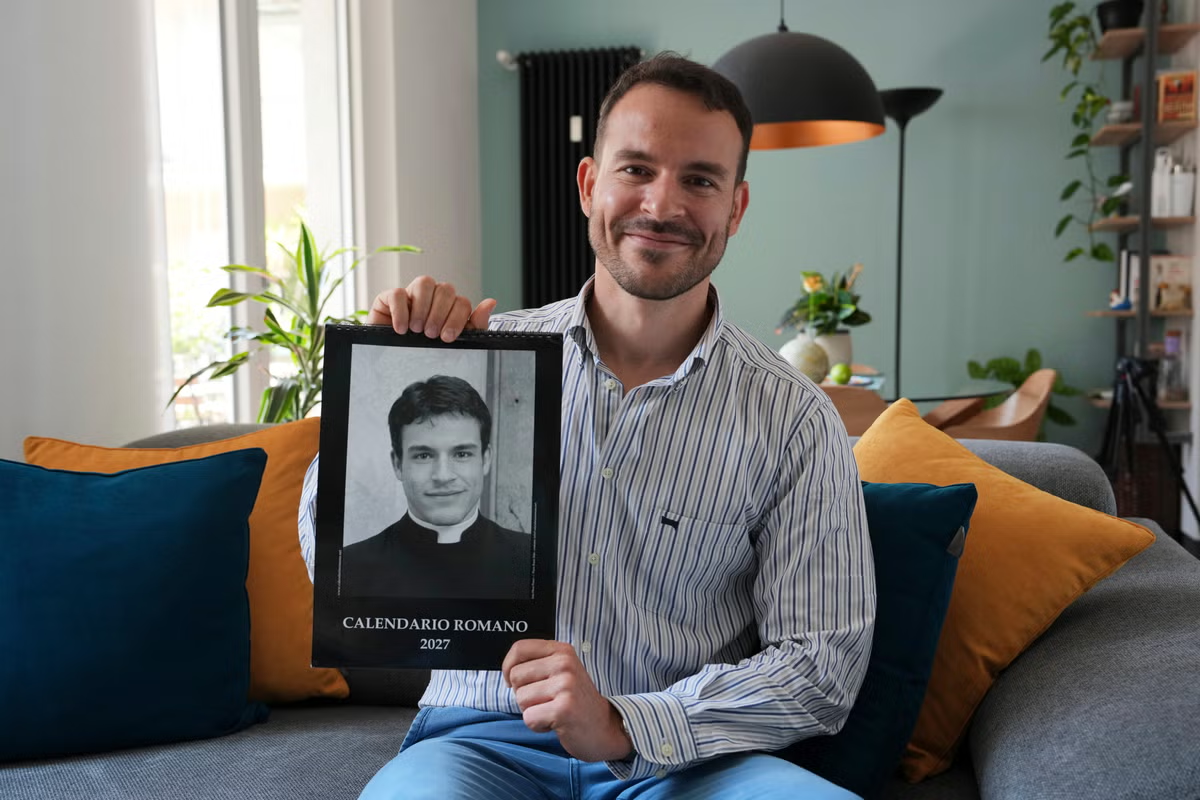
For two decades, a popular Rome souvenir featuring close-ups of young, handsome men in priestly attire has graced countless walls but it has now emerged that few of these alluring figures are actually men of the cloth.
The long-standing cover model, Giovanni Galizia, whose enigmatic smile has adorned the so-called “sexy priest calendar” for many of its 23 editions, is among those who never took holy orders. Galizia, now a 39-year-old flight attendant for a Spanish airline, was just 17 when he posed for the photograph.
He recalled the shoot as a “lark,” telling The Associated Press: “It was the smile of an embarrassed kid, because I saw all my friends in front of me laughing out loud because I was dressed like I was a priest.”
The image, showing him in a clerical collar against a granite church wall in his native Palermo, has been recycled year after year. This week, a story in the Rome daily La Repubblica brought nationwide attention to the calendar, revealing it could be more accurately dubbed “the fake priest calendar.”
The Vatican has declined to comment on the matter, as the calendar is not affiliated with the Holy See.
Officially named Calendario Romano, each edition showcases 12 black-and-white portraits of men, mostly in clerical attire. Photographer Piero Pazzi, who also creates a calendar of Venetian gondoliers, was behind the lens.
Galizia confirmed he only knew one other subject in the calendar, a French man, who was also not a priest. Pazzi, however, said that at least one-third of the models in the already released 2027 calendar are indeed priests, though he offered no further details.
Despite his widespread image, Galizia says he has never been recognised on the street, though his cousins once gifted the calendar to their grandmother, “and they all died laughing.”
Both Galizia and Pazzi insist the calendar was intended as art, not deception. Galizia draws a parallel to actors playing priests in TV dramas, noting that no one assumes they are actual clergy.
He explained: “Of course, it winks a bit at the dynamic between the sacred and the profane, because it is clear that seeing a world that is distant and in some ways so lofty as the ecclesiastical world, with such a fresh-faced young man, creates a kind of dissonance.”
He expressed bewilderment at the “sexy” interpretation of the black-and-white close-ups, a sentiment echoed by Pazzi.
“There’s a tendency to confuse what is beautiful with what is sensual, because nowadays, especially in today’s world, which is quite sexualized, beauty is expressed only through sensuality,” Galizia mused, adding: “That said, I appreciate the observation and take it as a compliment — because managing to be sexy in a priest’s collar is no small feat.”
Pazzi estimates several thousand copies of the Roman calendar are sold annually, though he wouldn’t disclose exact figures. While Pazzi receives royalties, Galizia, who signed a release form at the time of the photo shoot, has never sought payment. The calendar retails for around 8 euros in shops surrounding the Vatican and throughout Rome’s historic centre, with one shop clerk, Hassam Mohammad, reporting sales of a handful daily.
Despite its unofficial nature, the calendar has found an unexpected advocate in Father Domenico, a South Korean priest. Walking near the Vatican, he noted the calendar’s popularity in his home country, particularly among young people who view it with humour.
“They often think priests are stiff and distant,” Father Domenico said. “But looking at this calendar, they think priests are more familiar, and priests can be funny. I think in Korea this calendar is very famous, and it is OK.”