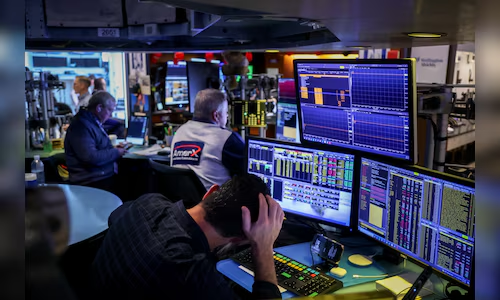
US stock futures slipped on Tuesday, extending the recent pullback in tech-heavy counters as investors weighed easing geopolitical tensions in West Asia against rising bond yields and concerns around overheated AI valuations.
Futures tied to the S&P 500 fell 0.5%, while Nasdaq 100 futures dropped 0.8%. Dow Jones Industrial Average futures were down 131 points, or 0.3%, before the opening bell.
The selloff in semiconductor stocks continued to weigh on sentiment, with the Philadelphia Semiconductor Index sliding 6% over the last two sessions as investors booked profits amid concerns around stretched valuations and the sustainability of elevated data centre spending.
Chipmaker Micron Technology declined another 2% in premarket trading, marking its fourth straight day of losses despite the stock still being up more than 138% this year. The decline followed a 7% drop in Seagate Technology on Monday after the company warned about challenges in keeping pace with demand. Seagate shares were down another 3% on Tuesday.
AI bellwether NVIDIA also remained under pressure, slipping 0.8% ahead of its closely watched quarterly earnings scheduled for Wednesday. The results are expected to serve as a key test for the broader AI-led market rally that has powered US equities to record highs in recent months.
Separately, AI infrastructure stocks also came under pressure after Blackstone and Google announced a joint venture to build a new AI computing business offering cloud infrastructure and access to Google Cloud’s Tensor Processing Units (TPUs).
The development weighed on cloud computing firms CoreWeave and Nebius, which fell about 3% in premarket trade amid concerns over intensifying competition in the AI infrastructure space. Blackstone said it plans to invest an initial $5 Bn in the venture, with the first 500 megawatts of power capacity expected to go live by 2027.
The pressure on equities also came from rising Treasury yields, with the benchmark 10-year yield climbing above 4.6% again. The 30-year Treasury yield hovered near 5.15%, close to its highest level since 2023, amid mounting fears that inflation could remain elevated for longer.
Investor concerns around inflation have intensified following a surge in oil prices linked to tensions in West Asia and disruptions around the Strait of Hormuz. The move has prompted Wall Street to increasingly speculate that the US Federal Reserve could raise interest rates again this year instead of delivering anticipated rate cuts.
However, crude prices eased slightly on Tuesday after US President Donald Trump said he had called off a planned military strike on Iran following requests from Gulf allies and ongoing “serious negotiations” around Iran’s nuclear programme.
West Texas Intermediate crude futures fell 0.4% to $103.81 per barrel, while Brent crude declined 1% to $110.96.
Despite the recent weakness, markets remain near record territory after a sharp rally over the past few months. The S&P 500 and Nasdaq recently touched fresh highs, while the Dow briefly reclaimed the 50,000 mark.