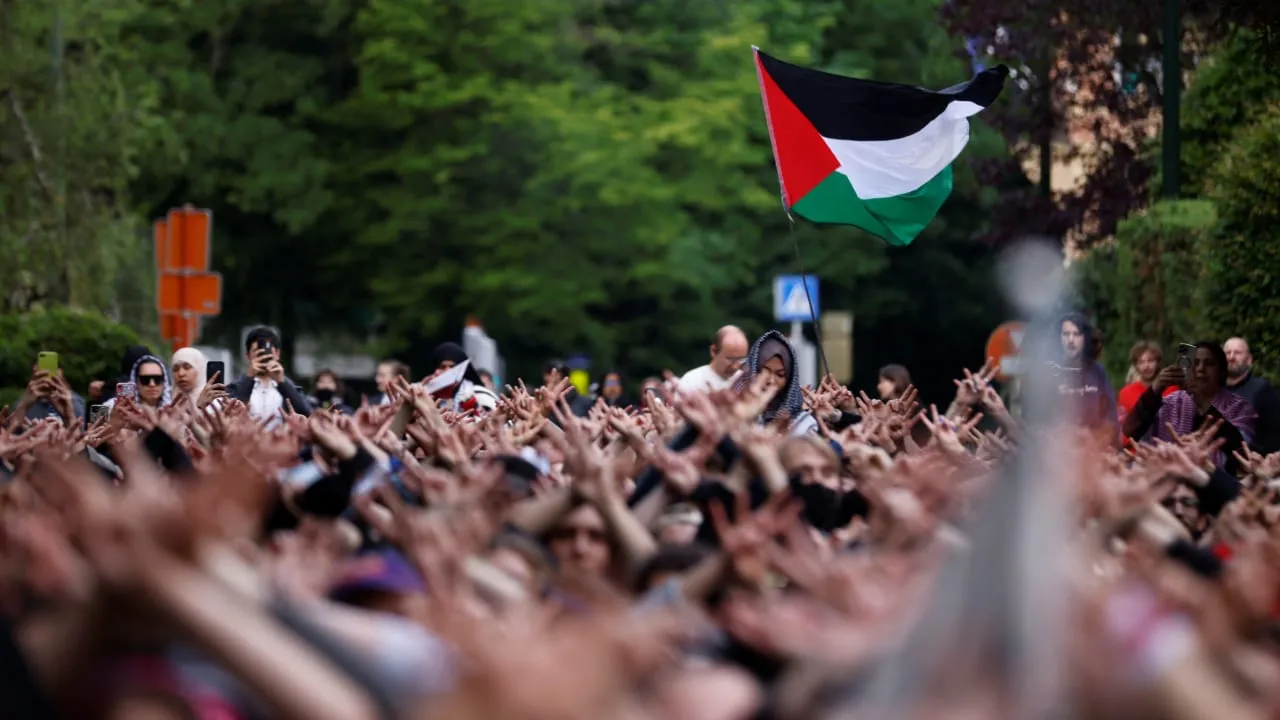
In 2025, deaths from terrorist attacks fell by 28%, and the number of global incidents declined by 22%, according to the 13th edition of the Global Terrorism Index.
At first glance, the data suggest an overall easing of the threat. Yet the picture is more uneven: terrorist attacks increased in Western countries over the past year, accounting for seven of the 19 states where conditions deteriorated.
About 3,000 km. from mainland Europe, 10,000 km. from the United States, and 13,000 km. from Australia, a single attack on Israel sent shock waves of radicalization that have reverberated far beyond the region. October 7, 2023, marked a turning point in global security.
The European Union Terrorism Situation and Trend Report 2024 notes that Hamas’s attack, in which more than 1,200 people were killed, has contributed to a renewed surge in global terrorism and helped accelerate patterns of fundamentalism.
In 2023 alone, there were 120 terrorist incidents across seven EU member states, including 98 completed attacks, nine failed attempts, and 13 foiled plots.
Former counterterrorism operative explains what draws youth to extremism
Mubin Shaikh, a former undercover counterterrorism operative for the Canadian Security Intelligence Service who later worked with US security services to counter the threat of ISIS, told The Jerusalem Post that he has observed a growing number of referrals to the organization Parents for Peace, where he now works as an exit peer specialist.
Shaikh explained that Hamas’s October 7 attacks and the ensuing war have drawn more young people into a complex conflict environment without the information, cognitive maturity, or analytical tools needed to understand it fully.
“What we’re finding in Parents for Peace is that antisemitism becomes like the connective tissue between all different extremist groups – Islamist, Marxist, etc. The hatred of Jews is a common denominator among them,” he explained.
Though not discounting the effect the Internet and media can have, Shaikh said young people were becoming drawn to extremist groups, as they could offer something they lacked, whether it be respect from peers, friends, validation, and, in many cases, support from an older male role model.
“At high schools, or schools in general, it’s peer groupings that are going to really get people mobilized. It’s one thing to have an idea about [a social issue]; it’s another thing to actually mobilize physically, get out there, participate in events, in protests, and get more extreme to [the point of committing] crimes,” he commented.
Some radicalized actors motivated by ideology, desire for recognition
Noor Dahri, founder and executive director of the Islamic Theology of Counter-Terrorism think tank, said he also understood “many lone actors appear to be motivated by a mix of ideology and the desire for recognition.
“Some are strongly ideological, while others appear driven more by personal grievances, identity struggles, or the visibility that social media can provide.
“Ideology may give their actions meaning or justification, but the pursuit of attention and significance can be just as influential,” Dahri explained, pointing to factors such as isolation, identity crises, and personal grievances as key factors in identifying individuals at risk of radicalization.
Dahri has previously spoken with the Post about his own journey of deradicalization as a former member of Lashkar-e-Taiba (LeT), the same group that committed the Mumbai Chabad attack in 2008, in addition to several attacks on India and the Kashmir region.
The line between holding an opinion and acting on it is often shaped by a desire to belong, Shaikh explained.
That peer pressure can manifest in different ways, including accusations of supporting genocide if individuals are absent or perceived as insufficiently vocal, or scrutiny over why they did not attend certain events.
When combined with the positive reinforcement and moral validation that come from public participation, young people, particularly those on the social margins, may find it difficult to resist the pressure to fully commit.
“Muslims are really good at putting converts on a pedestal. So this kid, who’s a nobody and has no friends, is suddenly being told, ‘Oh, you’ve been selected by God. What a great favor on you; you are such a great person. God is going to give you double the reward because you were not born Muslim; you became Muslim.’ When you’re telling a kid from that profile all these things, oh my God, it gets to their head,” he explained.
Converts to Islam may be at higher risk for radicalization
Shaikh suggested that converts to Islam may be at higher risk of radicalization, while also noting that attacks linked to white supremacists and incel ideology have risen in recent years.
According to Europol, 78% of the 426 arrests for terrorism-related offenses in Europe in 2023 were linked to jihadist activity.
While that may have reflected the pattern at the time, Shaikh cautioned that radicalization today is increasingly fluid, with individuals “mixing and matching” ideological identities, ranging from white youths converting to Islam to Muslim youths gravitating toward incel communities, an evolution he attributed in part to the influence of online ecosystems.
Dahri agreed that, to some extent, there has always been a degree of mixing among radical groups that seemingly hold ideologically opposing views.
“The segments of the Western far Left and socialist activism have helped create space for Islamist movements to sustain and expand within Western societies, a dynamic often described as the red-green alliance.
“From this perspective, Islamist organizations and their supporting regimes have always sought alliances with local Western supporters because they can serve as visible advocates while shielding core Islamist networks from scrutiny,” he explained.
“In this view, far-left activists are used as political cover, enabling Islamist groups and regimes to operate more effectively within Western states.
“This pattern has persisted for decades, with some activists effectively being mobilized in support of Islamist causes.”
Timing is key for radicalization
Another key factor determining whether someone simply becomes politically active or radicalized is timing.
Shaikh explained that when someone is experiencing a “cognitive opening,” they become more receptive to views they would normally discredit.
While near-death experiences and the loss of a loved one are often cited as the most common moments for a “cognitive opening,” for Shaikh, it began at a house party.
When family members shamed him after he was caught at such an event, Shaikh decided to travel to India and Pakistan for a few months with the express goal of becoming religious, something that he felt would restore his image in the community.
Having attended both a secular day school and a Quranic school, he spent years in a near-constant identity crisis, shaped by what he described as “cross-cultural pressure.” The trip ultimately gave him space to resolve that tension and commit to a single identity.
A chance encounter with the Taliban in Quetta, near the Afghan border, then provided a further catalyst, pushing him toward Salafism, an ultraconservative, fundamentalist reform movement within Sunni Islam.
The meeting took place when he was only 19 years old, in 1995, a year before the Taliban came to power in Afghanistan, meaning Shaikh was unaware of the brutally repressive policies the group would later impose, and reports of any violence until that point could be explained away as “propaganda.”
The chance meeting left him “enamored” with the group. It gave him the religious identity he sought, a sense of masculinity, and a feeling of belonging to something greater than himself. “It gave me that new identity that I thought I needed,” he explained.
After returning to Canada, he became close to several Salafi fundamentalists, though his enthusiasm for the movement waned after he married, had a child, and took on other responsibilities.
His new wife, a convert to Islam, exposed him to the treatment of Muslim women during the couple’s trip to India, forcing him to confront the gap between his own Western assumptions about gender roles and the ideals he had once associated with Taliban members he had previously admired.
An ideology less easy to detach from was antisemitism, though he said that it was easier for him as an Indian Muslim not bound by Arab nationalism.
“It’s like you’re taught that you’re supposed to subscribe to these views, and then you kind of practice it in your head, maybe on the street….
“The most I got to was I’d see a synagogue and [have feelings of] dislike [toward it]; hostility is what’s evoked…. I saw the synagogue, and I was like, ‘Oh man, I wish I could blow up the synagogue right now,’” he explained, quickly adding that he never had any real intention of attacking the Jewish community but felt the views were something he needed to practice.
“It was peripheral, but it still makes up the larger narrative, if you will. You’re against the West; you’re against the Jews. The Jews are seen as an extension of the West. It’s the same things that animate all these anti-Israel and anti-Jewish protests,” he continued.
His time following Salafi Islam, which had already waned, came to a hard stop in the year that preceded the famous “Toronto 18” case.
The case involved a group of 14 adults and four youths who were arrested in June 2006 for a foiled homegrown terrorist plot inspired by al-Qaeda.
The 18 individuals had planned to carry out large-scale attacks, including bombings of the Toronto Stock Exchange and the Parliament of Canada, and the beheading of government officials.
Just after returning from Syria in 2004, Shaikh saw a news report on Mohammad Momin Khawaja’s involvement in the UK fertilizer bomb plot, where a group of terrorists collected 1,300 lbs. of ammonium nitrate for the purpose of creating high casualty events in and around London.
Shaikh recruited by Canadian Security Intelligence
Having recognized Khawaja from his own extremist days, Shaikh contacted the Canadian Security Intelligence Service, which went on to recruit him as an undercover operative, beginning his career in counterterrorism.
Now, rather than identifying terrorists, Shaikh spends his days trying to stop young people from crossing that line.
Referencing Randy Borum’s theory of radicalization, Shaikh explained that there are steps that precede a person’s transition from violent rhetoric to violence.
“‘It’s not right, it’s not fair, it’s your fault, you’re evil’ – that’s the progression into violence, because you have to dehumanize, you have to attribute evil, you have to attribute something greater to what the adversary is doing, for you to justify taking actions which normally you would not take,” he explained.
The actions of the in-group are minimized, while the actions of the out-group are amplified, as part of this process of justifying violence, he continued.
Shaikh’s understanding of the radicalization process has helped numerous youths step back from the edge, even if not fully abandon ideologies some might not agree with. He has used it to counter support for Hamas, noting that, as an Islamic movement, many of its actions cannot be justified even if Israel were committing crimes against the Palestinian people.
“I show the statement of the Prophet, peace be upon him, when he says, ‘Don’t kill the elderly. Don’t kill women. Don’t kill children. Don’t mutilate the bodies of the enemy.’ These were all things that they violated openly. So, Islamically it cannot be justified,” he said. “I tell them this is why God will never give you [the] victory that you desire, when you break his commandments, when you break his laws, especially the laws of war. How are you going to get any victory from that?”
Though many have attempted to sidestep this line of argument with whataboutism, Shaikh maintains that the “ends justify the means” mentality is un-Islamic, and justifying Hamas’s rapes, abductions, and murders is the same as “saying ‘Bism-illah’ over pork.”
Shaikh aims to prevent youth from losing themselves in extremism
Shaikh’s goal is not to make a Zionist out of a radically anti-Israel youth. His goal is to stop young people from destroying lives, including their own, by losing their sense of self to a cause. More often than not, that means filling a gap that’s missing in their lives or creating a sense of perspective.
Parents for Peace doesn’t tell young people to give up protests, he explained; it reminds young people that their parents are pouring their hard-earned money into institutions so they can get a degree, obtain a good job, and have a comfortable life.
“We’re making it practical for them,” Shaikh explained. “It’s not a moral debate that we’re having, whether this is acceptable or you should love Israel; we don’t do any of that.”
When they have a family to support, when they enter the real world, “the grace of God” will not pay their bills, and they can’t afford to lose stable employment over a belief system, he said, adding that he uses his own story to highlight how growing up can mean abandoning these extreme notions of the world.
Kasim Hafeez’s own experience as a second-generation Pakistani Muslim further evidences much of Shaikh’s understanding of what can push someone to make the jump into extremism.
Hafeez was once a radicalized student with a deeply embedded hatred of Jews and plans to travel to Pakistan to enroll in a LeT terrorist training center. Now, he works for Christians United for Israel as a Middle East analyst and is a vocal advocate for Israel.
Born and raised in Nottingham, Hafeez was British in every formal sense. He held only a British passport and attended a state school in the UK.
Yet he grew up in a close-knit, insular community where traditions were carefully preserved, mosques served as the focal point of daily life, and many parents lived with the constant fear that their move to Britain would lead their children to abandon both Islam and the Pakistani culture they had brought with them.
White nationalists would also frequently make clear that he and his family were not welcome and he would never truly be considered English, he explained, recalling incidents of street abuse when he was as young as five.
Though he recalled antisemitism being a standard sentiment in his household and community, Hafeez denied that his parents and grandparents had been radical. As members of the first generation of migrants who came to the UK after World War II, they had personally witnessed the true cost of Islamic extremism and were uninterested in bringing such sentiments with them.
The second generation, born in Britain but not truly considered British by many, did not have such an understanding.
“Torn between these two identities,” Hafeez explained, many Muslims in his generation felt lost.
He explained that the deprivation often associated with the unskilled labor jobs many migrants take on in their new countries can foster feelings of anger, victimhood, and hopelessness.
These emotions, he suggested, often require only a small spark to erupt. In this case, that spark came with the 1988-1989 protests and book burnings surrounding Salman Rushdie’s The Satanic Verses.
“I believe that really opened the door to the level of radicalization we now have, because it opened this idea that Muslims in the West don’t really belong here; that there are their values and our values,” he said, highlighting in particular the fact that blasphemy is forbidden in Pakistan, and that living in the West means hearing views one may find offensive to their very core.
Hafeez explained that for second-generation Muslims in the West, the Soviet Union’s failure in 1989 became a source of pride, making mujahideen (those engaged in Islamic jihad) seem “like heroes.”
Eager to capitalize on this anger and wave of hero worship were groups like Hizb ut-Tahrir and al-Muhajiroun. Though the latter was first formed in Britain, Hafeez maintained that the terrorist recruitment was largely coming from sources external to his own community.
“You’re growing up; you’re feeling that you’re being deprived of something; you know that you’re different from the society around you, which you don’t really fit into; and now you’re a victim of that society, but you’re a victim of something that there is nothing you can do about it, like if the whole Western society is against you,” he explained.
“There’s nothing you can do about it, other than be angry, be frustrated, be depressed, and it creates this circle of hopelessness, which makes the message of these groups a lot more appealing.
“It’s giving you a belonging; it’s giving you kind of a way to address it, but not really; and it also then takes you down this path of ‘this is the way forward,’ and you start making these leaps of taking your situation and then identifying it with that of other Muslims and drawing these other parallels that may not exist, and unfortunately it’s very easy to fall into.”
Jump to extremism often helped by exposure to antisemitism
That jump is often aided by the background antisemitism Muslim youth are exposed to from birth, he continued. Hafeez shared that, though they are largely nonsensical in retrospect, antisemitic explanations for his position in the world had once provided a sense of clarity.
“Pakistan has never had a significant Jewish population post-partition, and so this obsession with Israel is kind of weird. Obviously, they’re just drawing it from the wider Arab world, etc. But it was really common… like day-to-day.
“[The Nottingham community was] not a radical community, not an extremist community; like, no one is trying to implement Sharia law or overthrow the government, or even talking about that.
“But antisemitism was super common, like calling somebody a Jew as an insult, [saying] the Jews control America and the media,” he continued.
“You take it on without even realizing. When you hear it day after day, it’s just normal conversation. It doesn’t become an opinion or like a crazy conspiracy theory. It just became a fact because I didn’t know anyone Jewish. I had never spoken to anybody Jewish in my life, so those narratives became the reality.
“So when you have, years later in life, a well-organized group of people who are now touching on to other parts that you’re looking for in your life, and then drawing the connection that all the negatives are because of the Jews, it kind of makes sense.
“There was just such a level of anger and hatred toward this one group because I see them as responsible for all the ills happening in the Muslim world,” Hafeez shared, adding that he has struggled to come to terms with the guilt of knowing he once perpetuated the same type of prejudice he had suffered as a minority.
Naturally, Hafeez’s views only became more radical at university, as he was regularly handed flyers of limbless children alleged to be Palestinian victims of Israel. It was here that the active dehumanization of Israelis started, and after a trip to Pakistan in 2000, he began to think about joining LeT.
Pro-Palestinian sentiments often begin from a place of genuine humanitarian concern and are capitalized upon by extremist groups. As Dahri explained, “Extremist rhetoric can become normalized when it is presented in emotionally persuasive humanitarian or political terms, because people may respond to the moral framing rather than recognize the underlying extremism.
“Newly established Islamist regimes can use this approach to portray themselves to the global Muslim community as nonviolent and consistent with Islamic teachings, while justifying past armed struggle as a response to unjust Western policies toward Muslims. Through humanitarian activity and claims of justice, they seek to present themselves as peaceful, benevolent, and motivated by service rather than self-interest.”
Like many young people, Hafeez viewed the world through a rigid set of binaries. Jews were bad. Israel was evil. Muslims were victims. Islamic jihad was a natural response to the West’s perceived injustices. That worldview began to unravel when he came across Alan Dershowitz’s The Case for Israel.
He came across the book in the chain bookstore Waterstones, drawn by its bold blue Star of David on the cover. At first, he scoffed at it, dismissing it as Jewish propaganda, and picked it up believing he could easily refute all of Dershowitz’s arguments. He couldn’t.
“The way I was approaching faith at that point was very dogmatically; everything needed a source… but what Dershowitz’s book did was it created doubt. I didn’t read this one book and was like ‘well, I got it wrong; who knew?’” he recounted. “It just doesn’t work like that, and I initially set off to prove it wrong. I started looking outside of my own echo chamber, outside of leaflets from Friends of Al-Aqsa, and I was getting a very different picture of things.”
Even attempting to spend time refuting the facts laid out in the book was “isolating,” as members of his community urged him to accept the information he had been taught as fact and leave it at that.
Plagued with the idea that “all this anger and venom and energy” he had put into his antisemitic belief system could be wrong, his entire worldview could be wrong, he decided the only option was to visit Israel and discover the truth firsthand in 2007.
With little experience traveling alone, Hafeez followed UK travel guidance to the letter and answered every question truthfully when he arrived at Ben-Gurion Airport.
His candid admission that he disliked Jews and Israel and had come to see whether the country was as evil as he had been taught led to an eight-hour interrogation. He was ultimately released, however, and allowed to explore the country for himself.
“Eight hours was a long time, but it wasn’t a bad experience, and that was the first time I’d spoken to an Israeli,” he commented.
“When I look back, I think what it was about Israel [that changed my view] was just the normality of it. It was not like anything I expected, and just being able to walk around, speak to random people, just the humanizing effect of that, was incredibly powerful.”
The trip proved to be a turning point for Hafeez, who began dedicating serious time to understanding the other side of a conflict he had heard about for much of his life. He visited museums, read books by Jewish and Zionist authors, and immersed himself in research, hoping to bring that knowledge back to his own community, a community that was less than receptive.
“I was just talking to friends and family, like, ‘Hey, I went, and this is my experience.’ I didn’t expect the backlash that I got. Maybe I was naive, maybe stupid,” he shared.
Though Hafeez never denounced Islam or insulted God in any way, he was treated as if he had committed an act of blasphemy. He received death threats, was thrown out of his mother’s home, and was repeatedly accused of being funded by Jerusalem.
“I get death threats all the time on social media, and I’m like, ‘You can’t even spell properly; I’m not that worried.’ But it’s always a little disconcerting when you start getting death threats left at your actual front door. That’s a little like ‘this is not fun,’” Hafeez opened up, seemingly covering up a very painful period of his life with British humor.
After he submitted an article to The Jewish Chronicle, he was invited to give speeches across the country, and his relationship with his family further deteriorated.
Asked why he would endure all of that, including the familial ties that never fully recovered, Hafeez answered that there were two main reasons.
Firstly, he felt a tremendous weight of guilt at the hate he had put out into the world, the hate he had himself experienced.
Secondly, he hoped that sharing the information could save other Muslims from living a “horrible” life where everything is “clouded by anger.”
“It’s just not a pleasant way to live mentally or in any way, and then you end up going down a really dangerous path, and I just thought, if speaking out can prevent one person from going down that path, then it’s worth it,” he shared.
Concluding the interview, Hafeez said he found it particularly difficult to accept the type of extremism being embraced by white young people, who will be largely untouched by the consequences it breeds.
“I see middle-class white people who are like ‘Free Palestine’ and all in, [and] it’s like, yeah, you can say this and go home. It’s not your community that the real hardcore extremists are targeting. It’s not your community that the actual jihadist groups are targeting to pull your kids, your cousins, or your nephews away into much deeper and darker things.
“And then, when those things come to a terrible conclusion, when there’s a terrorist attack, it’s not your community that has to deal with the blowback of it,” he stated.