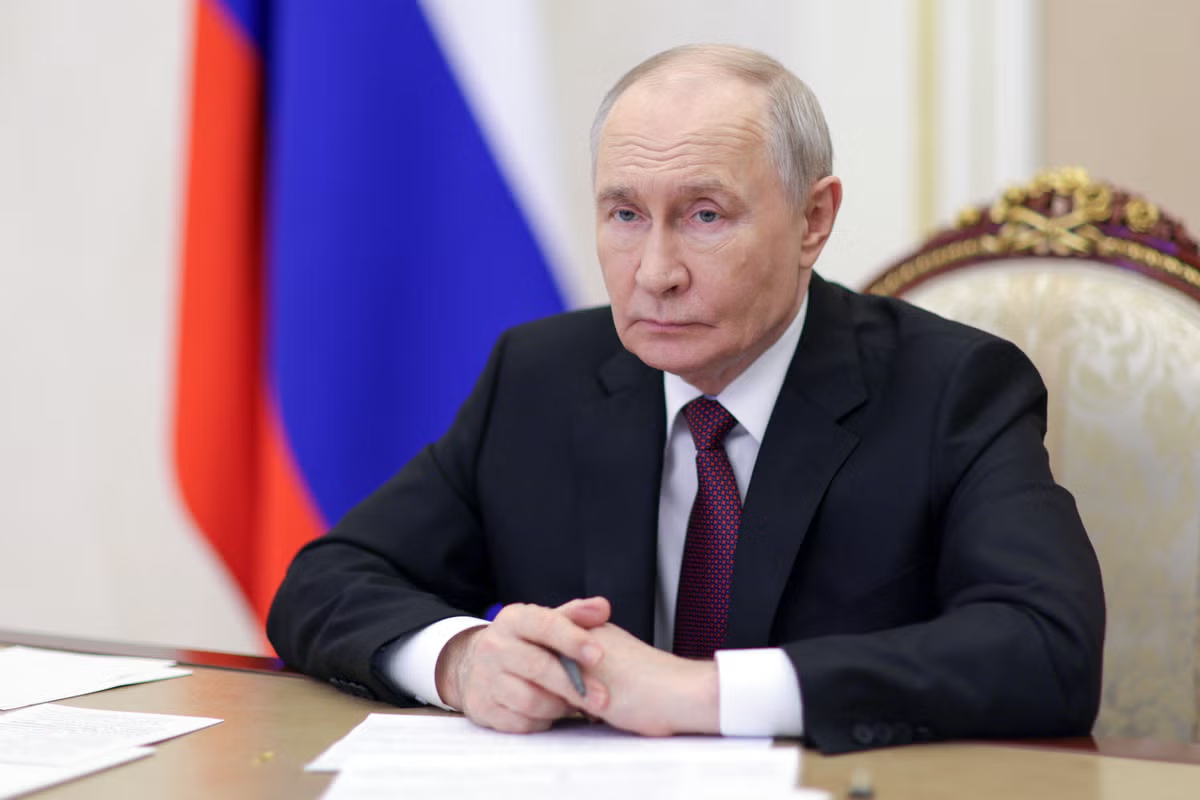
Russia is losing its war against Ukraine. Proof of this has come from Vladimir Putin himself, who has issued a desperate call for a return to peace talks while his oil refineries burn and his bridges to occupied territory are pounded by Kyiv’s missiles.
Russia’s president has been badly rattled; his airports are closed, his military logistics chain has dangerously snapped, and public support is waning for a war he started, and for which Russia’s national media can no longer generate artificial enthusiasm.
His minions have been whining that an agreement they believe was struck with Donald Trump at the Anchorage summit with Putin last year – giving Moscow colonial ownership of 20 per cent of Ukraine – has been abandoned by the US president as he prepares to meet Nato’s secretary general Mark Rutte.
Trump likes to back a winner. So far he has backed Russia, which invaded a democratic European nation at full scale in February 2022.
Now may be the time for Rutte to explain to the 47th president of the US that his Nato allies are indeed pulling their weight without US help (aside from intelligence) in Ukraine.
All he needs to do is repeat what Putin said earlier this week, when he asserted that Ukraine’s attacks on Russia’s oil infrastructure and other logistics operations are an attempt to “destabilise society”.
And clearly, Putin believes this is working.
“Russia, as has been stated repeatedly, is ready for peace negotiations with Ukraine,” he said on Monday, in what amounted to a plea to get back to the days when Ukraine’s Western allies believed that Kyiv was losing and that some kind of peace should be agreed with Moscow.
“It is ready to proceed on the basis of the agreements reached back in Istanbul – agreements which, I would remind you, were initiated at the time by the Ukrainian delegation.”
Back then, the view endorsed by many in the British Foreign Office, and by serving officers in Britain’s armed forces, was that Ukraine should sue for peace. It was wrong back then, as The Independent argued – and it is evidently wrong again now.
Further proof comes in the repeated complaints from Kremlin officials that Trump does not appear to be the same enthusiast for Russia as he has been for most of the last 18 months – when he cut all military aid to Kyiv, and exaggerated what the US had spent by almost three times, saying it was $300bn (it was closer to $120bn), not to mention the repeated insults and bullying sessions endured by Volodymyr Zelensky, Ukraine’s president.
This week we have seen Russian Soviet-style revisionism on what the Anchorage summit delivered. It had been seen as a capitulation to Moscow by America’s allies.
But now, as Ukraine has gained momentum against Russia with complete domination of the Black Sea, and forced Moscow to consider a ban on diesel exports after Russian refineries were hit with long-range missiles, the Kremlin’s spokesmen sound hurt and outraged.
Trump has been distracted by his war against Iran, which has also enhanced Ukraine’s reputation after Kyiv offered anti-drone defences to America’s Gulf allies.
He has lost his war in the Middle East so far. Now he may be looking for an easy win, and this, the Kremlin knows, is an opportunity for Zelensky.
Kremlin aide Yuri Ushakov said on Sunday that only one side had remained committed to the understanding agreed in Anchorage that Moscow could grab a chunk of Ukraine in return for “peace”.
For exclusive reporting from Sam Kiley and Bel Trew, sign up for our On The Ground newsletter here.
“The other side, as it now appears, has not been fully able to do its part,” he said, referring to the US – not Ukraine.
On Tuesday, Russia’s foreign minister Sergei Lavrov suggested that the Anchorage summit might have been a US “ploy to buy time to rearm the Kyiv regime”.
His deputy, Sergei Ryabkov, also accused the US of departing from the “fundamental understandings” reached in Alaska, according to Interfax.
“We also see Washington’s line moving closer to the most rabid anti-Russian policies pursued by the US’s closest European allies – namely, the UK and France,” Moscow’s news agency RIA quoted Ryabkov as saying, after Zelensky and Trump met at the G7 last week.
Crimea, illegally seized by Russia in 2014/15 and occupied ever since, has been especially badly hit by Ukraine’s air campaign.
Mikhail Razvozhayev, the Russian-installed governor of Sevastopol, home to Russia’s Black Sea fleet, announced “enforced temporary measures” this week, including the shutting down of public transport at 10pm, and the closure of large shops and cafes at 8pm.
Fuel shortages are beginning to cripple Russia’s greatest prize in Ukraine.
The UK and European allies have been struggling with how to expand their defence capabilities rapidly without crippling their national budgets.