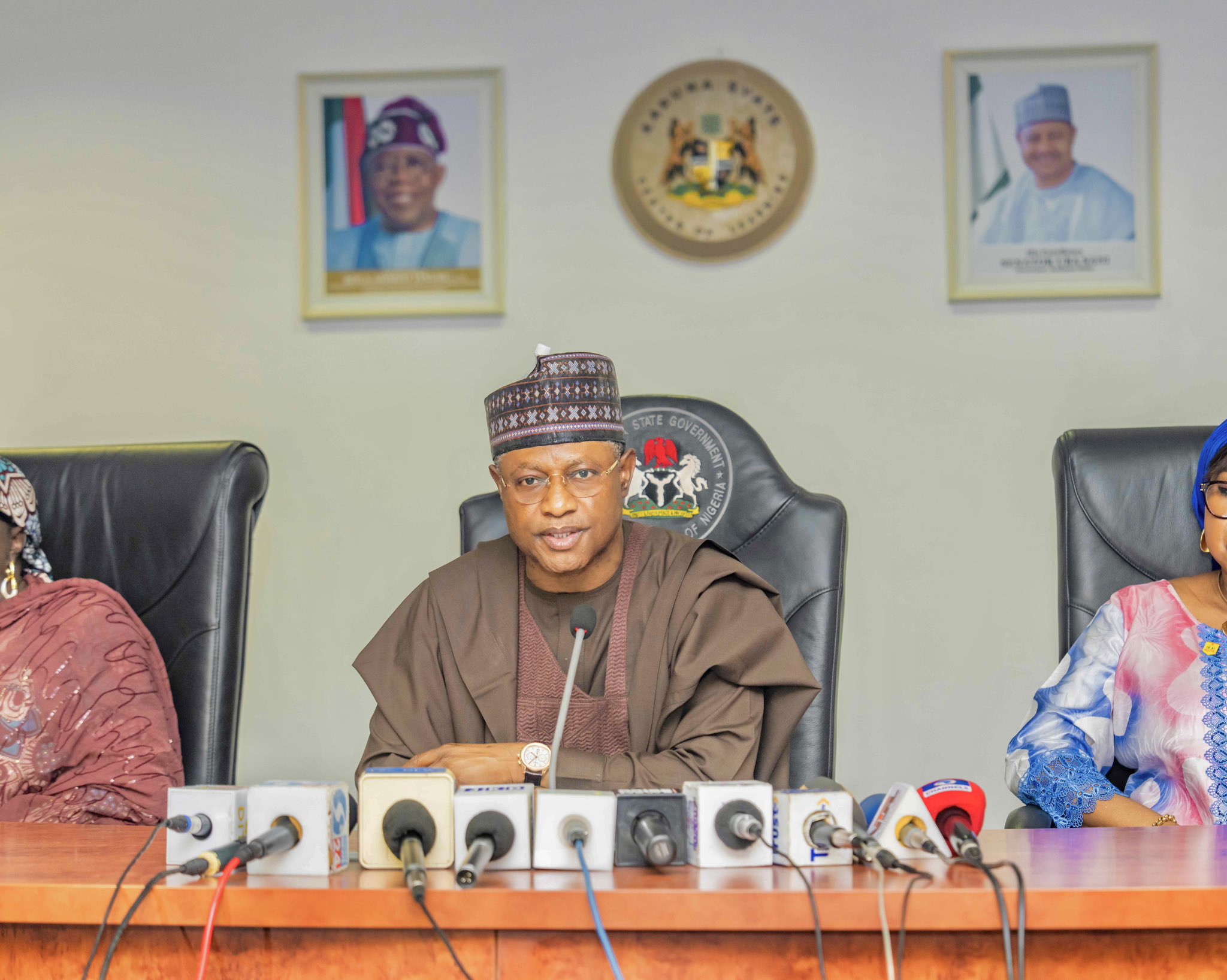
Kaduna governor dismisses fears of abuse, says governors are ready to fund state police as insecurity continues to fuel calls for decentralised policing.
Governor Uba Sani of Kaduna State has defended the proposed establishment of state police, describing it as the most practical solution to Nigeria’s worsening insecurity and dismissing concerns that governors could use the outfit to intimidate political opponents.
Mr Sani spoke on Channels Television’s Politics Today programme on Wednesday, hours after the Senate passed a bill seeking to establish state police services across the federation.
The governor, one of the leading advocates of state police, said the proposed legal framework contains sufficient safeguards to prevent abuse by state governments.
His comments come amid national debate over security reforms and growing concerns over persistent attacks, kidnappings, and banditry across the country, particularly in the North-west.
In Kaduna State, insecurity remains a major challenge despite recent gains recorded by security agencies.
Communities in parts of Southern Kaduna, Birnin Gwari, Giwa, Chikun, Kajuru, and Kachia have continued to report incidents of kidnapping and attacks by armed groups.
In recent weeks, Christian groups and community leaders in parts of Kaduna urged government to intensify efforts to protect lives and property.
Against this backdrop, Mr Sani argued that state police would enable a more effective and localised response to security threats.
“There is nothing political about state police. The objective is to improve the protection of lives and property and strengthen security at the grassroots,” he said.
The governor rejected claims that governors would have unchecked powers over state police commissioners, insisting that the proposed law establishes multiple layers of oversight.
“I can tell you today that you can appoint the commissioner of police, but you cannot sack him. That is the issue. You can’t even sack him through the state assembly alone,” Mr Sani said.
According to him, the removal of a state police commissioner would require approvals involving the Police Service Commission, the Police Council, the National Assembly, and the State House of Assembly.
“There are a lot of safeguards to stop abuse. They are clearly provided for in the Act,” he added.
Addressing concerns about the financial implications of maintaining state police formations, Mr Sani said governors were prepared to shoulder the responsibility.
“I believe governors are ready. For me, funding is not a problem,” he said.
The governor argued that states have demonstrated increasing capacity to finance critical sectors and would be willing to invest in security if given constitutional authority to do so.
He maintained that the benefits of improved security would outweigh the financial burden associated with establishing and maintaining state police structures.
President Bola Tinubu on Tuesday transmitted to the Senate a bill seeking to amend the 1999 Constitution to provide for the establishment of state police services across the country.
The Senate passed the bill on Wednesday, moving the proposal a step closer to becoming law.
If eventually approved by the National Assembly and assented to by the president, the legislation will replace Nigeria’s current centralised policing framework with a dual system comprising a Federal Police Service and State Police Services.
The proposal represents one of the most significant security sector reforms since Nigeria’s return to democratic rule in 1999.
For years, governors, traditional rulers, security experts and civil society organisations called for decentralised policing, arguing that the current structure has become overstretched and inadequate for addressing increasingly complex security challenges.
However, opponents warned that the system could be exploited by state governments to target political opponents, suppress dissent and interfere with democratic processes.
Mr Sani, however, insisted that such fears were misplaced, arguing that those opposing the initiative had either not studied the provisions of the bill or failed to appreciate the safeguards built into the proposed law.
He expressed confidence that Nigerians would ultimately embrace state police as a necessary step towards addressing the country’s persistent security challenges.