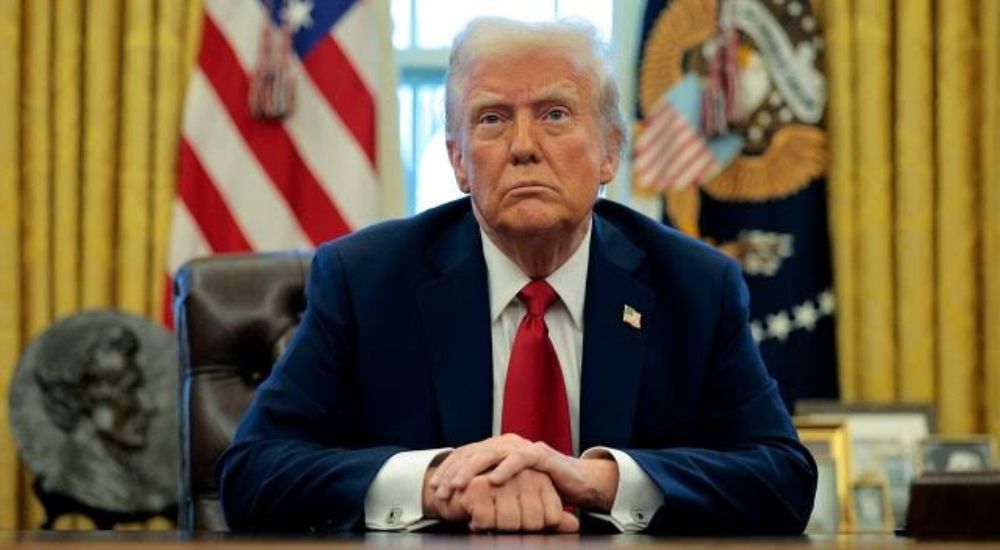
United States President Donald Trump has dismissed reports that Washington plans to pay Iran $300bn under the recently signed memorandum of understanding, describing the claim as “Fake News.”
Trump made the clarification in a statement shared by the White House on Thursday amid growing debate over the implications of the agreement between the two countries.
Rejecting suggestions that the deal contains any financial payout to Tehran, the U.S. president maintained that the agreement serves American interests and would contribute to lower oil prices and broader economic gains.
“There is no 300 Billion Dollar payment to Iran by the U.S.. That’s Fake News! All there is for the U.S. is Success, Lower Oil Prices, and Victory. Check out the Stock Market. Dumocrat propaganda at play!!!” Trump said.
The president’s remarks followed days of controversy over reports that a proposed $300bn reconstruction and investment fund could form part of the broader U.S.-Iran agreement.
The reports gained attention after Vice President JD Vance explained that Iran could potentially benefit from a large-scale reconstruction and investment programme if it complies with the terms of the deal.
Vance, however, stressed that the funds would not come directly from American taxpayers but from Gulf partners and private-sector investors.
Critics of the agreement have argued that such an arrangement could still provide substantial economic benefits to Tehran, regardless of the source of the funding.
Supporters, on the other hand, maintain that the proposal is aimed at encouraging compliance and regional stability rather than providing direct financial assistance to Iran.
Trump, however, insisted that reports portraying the arrangement as a $300bn U.S. payment to Iran were inaccurate and politically motivated.
The agreement has continued to generate reactions from supporters and critics, with debates focusing on its potential impact on regional stability, global energy markets and U.S. foreign policy.
The controversy over the figure first erupted when Iranian state-affiliated media leaked a 14-point summary of the draft peace framework.
Domestically, Tehran media outlets and hardline factions aggressively promoted the $300bn figure, triumphantly framing the investment vehicle as “reparations” forced upon Washington to cover the massive infrastructure damages sustained during the fierce 100-day war.
Independent investigations quickly confirmed that a $300bn framework is explicitly written into the 6th point of the actual Memorandum of Understanding, which commits the US and its regional partners to developing a comprehensive economic rehabilitation plan for Iran.
The announcement that the electronic text had been officially signed came directly from Pakistani Prime Minister Shehbaz Sharif, who, alongside Qatar, has been acting as the lead mediator brokering the historic peace talks.
Prime Minister Sharif confirmed the deal was locked in despite what he described as a relentless wave of domestic and international misinformation aimed at derailing the process ahead of the formal physical signing ceremony in Switzerland.
While Iranian Foreign Minister Abbas Araghchi attempted to dial down the public frenzy by urging state media to refrain from early speculation, the sheer scale of the financial package triggered severe political backlash for the Trump administration at home.
To quieten domestic critics who slammed the deal as a massive bailout for a hostile foreign regime, Trump and Vice President JD Vance clarified that the United States government will not be contributing a single dime to the fund.
Instead, the $300bn is structured as a strictly private equity investment vehicle financed by global corporations and wealthy Arab Gulf states eager to access Iran’s massive energy resources.
Furthermore, the administration stressed that the fund will remain entirely frozen during a 60-day transitional ceasefire, meaning Iran will not see any outside investment unless it strictly honours its obligations to dismantle its nuclear weapons programme and permanently dilute its enriched uranium stockpiles under intense international inspection.