WASHINGTON — President Trump canceled his planned signing Wednesday of the landmark housing bill Congress passed this week, in a striking decision to jeopardize a rare bipartisan success in order to demand that lawmakers pass voter ID legislation.
The president’s reversal, as a stage and chairs for the signing ceremony were set up in the Capitol and stakeholders were arriving on the Hill, underscored his fixation on asserting some federal control over election processes.
And it displayed a remarkable willingness to threaten a bill that he and his party could have framed as a win on affordability ahead of the midterm elections, as Republicans fight to keep U.S. House control amid economic dissatisfaction among Americans.
Hours before the president torpedoed the bill signing, the White House had said the measure was an example of a “promise kept.”
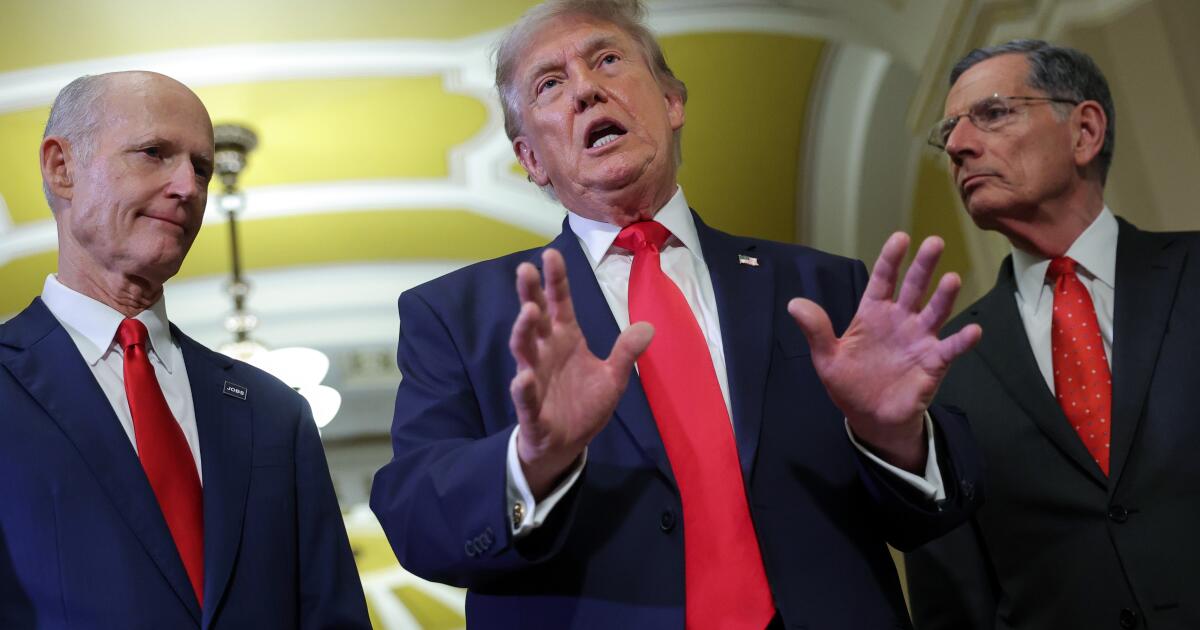
“Today’s Housing News Conference and Signing is hereby cancelled until such time as we pass the desperately needed SAVE AMERICA ACT, which I consider to be a National Emergency,” Trump wrote Wednesday morning on his social media website.
It opened a new front in ongoing tension between Trump and Senate Republicans, which already had neared a breaking point this week over the proof-of-citizenship bill. Senate leaders have told the president that the bill, dubbed the SAVE America Act, does not have the votes to pass.
And it shocked lawmakers who had been celebrating the bipartisan accomplishment. Rep. Maxine Waters (D-Los Angeles), who had helped lead negotiations, said Trump was “slapping millions of families in the face” after having supported the bill.
“Trump is making his promise crystal clear: If you’re dealing with high housing costs, you’re on your own,” Waters told reporters at a Democratic news conference Wednesday afternoon.
The housing bill, which passed with overwhelming support in the House on Tuesday evening and the Senate on Monday, aims to boost housing supply. It is the most significant legislation Congress has passed on housing in more than 30 years, and it contains a host of provisions aimed at removing regulatory barriers, improving federal programs and incentivizing new home building.
As president, Trump has 10 days to sign or veto bills after they are presented. If he takes no action and Congress remains in session, a bill becomes law. Rep. Katherine Clark (D-Mass.), the House minority whip, said Republican leadership had not yet presented the bill to Trump.
House Speaker Mike Johnson (R-La.) indicated to reporters Wednesday that a signing could still be on the table, saying he had spoken to Trump about “delaying” the housing bill before the president announced the cancellation.
“He decided — I didn’t announce it, I wanted him to announce it — but we’re delaying this,” Johnson said. “He has a window of time before he has to sign a bill and he’s going to use a little bit more of that window of time and we’re gonna go through this together.”
Johnson said he had promised an effort to advance the SAVE America Act, saying election integrity “is the top priority.” The speaker accused Democrats of wanting “to allow for cheating and fraud in the elections because it is the only way Marxists can win.”
The White House did not respond when asked whether the president planned to veto the bill or sign it later.
Jim Tobin, president of the National Assn. of Home Builders, which advocated for the bill, said he was on his way to the ceremony, getting ready to walk through Capitol security, when Trump posted.
It was “very disappointing,” Tobin said, citing two years of bipartisan work among industry leaders, lawmakers and the White House, but he said he believed the bill may still ultimately become law.
“People, I believe, want to run — back home — on the affordability issue,” Tobin said. “This would be a great feather in a lot of Congress members’ hats, as well as the president’s, so I’m confident that we’ll get there.”
Last week, the NPR/PBS News/Marist Poll and Fox News poll found record dissatisfaction with the economy among Americans and Trump’s support slipping among key demographics. The president also lashed out about that on his social media website earlier Wednesday, writing without evidence: “MY REAL POLL NUMBERS ARE THE HIGHEST THEY HAVE EVER BEEN. THANK YOU!!!”
Before Trump announced the cancellation, he posted about the legislation, labeling it “the Elizabeth ‘Pocahontas’ Warren centric housing bill,” and railed about the SAVE America Act.
His push for the election overhaul bill could be a test of Senate Republicans’ willingness to counter him.
In recent months, they have revolted against several of his priorities, including security funding for a White House ballroom and a $1.8-billion fund to pay people who claim to have been politically persecuted by the federal government. On Tuesday, four Republican senators joined with Democrats to approve a war powers resolution seeking to block U.S. military action in Iran.
Trump, who for years has tried to sow doubt in American elections, has pressed Republicans to pass the SAVE America Act ahead of the midterm elections. He has said the bill would “guarantee” the midterms for Republicans.
Frustrated that the bill has fallen short of the 60-vote threshold needed to pass the Senate, Trump has repeatedly pressured Senate Majority Leader John Thune (R-S.D.) to eliminate the filibuster rule. Thune has refused.
“He is trying to put pressure on the Senate and on his own caucus to pass an unpopular bill as part of his effort to interfere in the elections,” said Wendy Weiser, democracy program director at the Brennan Center for Justice at New York University. “We need to take seriously the possibility that he’s really trying to blow up the Senate over this.”
Earlier this year, Trump said he would not sign any other legislation before the election overhaul measure was passed, arguing that it “supersedes everything else.” He has threatened to not renew a key U.S. surveillance law if it does not include the voting law. And at a rally in Pennsylvania on Tuesday, the president said the election bill was needed because states such as California were trying to rig the election.
“California is totally rigged. All mail-in ballots, it’s a disgrace,” the president told the crowd.
In Washington, the voting law has already passed the House three times. But it has stalled in the Senate. Sen. Thom Tillis (R-N.C.) told reporters Wednesday that it was an “unachievable goal” to try to get the bill passed.
The legislation would require voters to provide proof of citizenship when they register, require Americans show identification when casting a ballot and require states to send voter data to the Department of Homeland Security.
Voting rights advocates say it would create unnecessary barriers to voting for citizens. There are less disruptive ways to verify a voter’s citizenship status, and the bill would also create administrative challenges for election officials, said Wren Orey, elections project director at the Bipartisan Policy Center.
It serves Trump to continue pushing the bill even without support to pass it, said Eric Kashdan, director of federal advocacy at the Campaign Legal Center; if Republicans suffer losses in the midterms, Trump may use the narrative that elections are vulnerable to fraud.
“If they can say that without the SAVE Act these elections are not secure, that lays the groundwork for the administration to possibly interfere in the elections or just sow doubt,” Kashdan said.
Rep. Brad Sherman (D-Sherman Oaks) said Trump was holding the bill hostage in a bid “to control California’s elections.”
“The stage was set both physically and metaphorically for the president to sign a historic housing bill for the American people,” said Sherman, who contributed a provision to the housing bill that would help disabled veterans get rental assistance. “Trump must put his ego aside and put the American people first and sign this bill into law.”