From scriptural accounts, histories, philosophies, mythologies and prophesies, names, especially those of humans, are far more than a means of identification. Whether the inspirations stem from occurrences preceding a child birth, place of birth, or what is expected to characterise the life of a person, experiences trailing certain names have amplified the intuitive knowledge of Africans, even among those without the sophisticated change agent of Western education.
Most meanings of names are hidden or obfuscated from knowledge of a wider spectrum of people because of obscurity or anonymity associated with actions of such names. Apart from giving prominence to names, public spaces, especially, leadership positions are platforms availing a vast number of people the knowledge of players at the public arena.
Attitudes deposited in humans come through actions. In any situation that action is pumped out, a who in a person comes to the fore. Hannah Arendnt, who lived between 1906 and 1975, and once posited: “Public life and political participation matter,” asserted at another instance: “Action without a name, a who attached to it, is meaningless.”
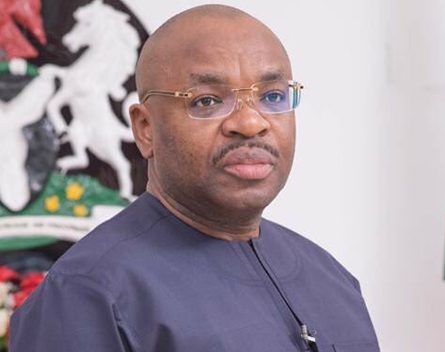
Although it was his profile of professional acumen in the banking industry and devotion to church development that substantially constituted his alluring personality that attracted then Governor Godswill Akpabio to draft him into the political office of the Secretary to the Akwa Ibom State Government in 2013, very little was known by a large populace about Udom Emmanuel’s personal characteristics. Until his assumption of office at the Government House in Uyo, his public outings were limited to Zenith Bank Plc head office at Ajose Adeogun, Victoria Island, Lagos and Qua Iboe Church, Surulere in Lagos.
While this piece is neither attempting to offer an overview nor evaluation of the goodness or badness of Emmanuel’s governorship days, effort is being made to portray how his political actions have been propping up the meanings of Udom. It is important to know that while literal definitions of names are not less significant, enduring meanings of names are seen more in characters displayed by individuals, especially when reputational qualities that come out have bearings on a wide range of people and possess marks of exceptional stance, at times and places that the easy preference to jump on the bandwagon are commonplace.
Udom is a masculine name among the people of Akwa Ibom State and parts of Cross River State. It is from the meaning of the name and a culture that places superiority considerations for men over women that makes it an exclusive reserve for males.
Udom, which simply means right, is a short form of a two-syllable word or a two-word phrasal now.
In full, the name can be written and pronounced Ubok Udom or Ubok-Udom, which means Right hand or Right hand person.
By inspiration and connotation, Udom implies pillar, cornerstone, strength, rigid, stable, reliable, steadfast, among their likes. In what shows unique and niche conveyed by African native names over foreign names, Udom Emmanuel has been launched into a club of few persons in Nigeria, whose first names are stronger than their surnames and have become a brand of their respective personal identities. Think of FELA Anikulapo Kuti, GANI Fawehinmi, ATIKU Abubakar, CHIMAMANDA Ngozi Adichie, UDOM Emmanuel!
When differences on who should become the next governor from May 29, 2023 broke out between Udom and his Chief of Staff, Ephraim Inyang, the latter, who was once the governor’s Man Friday, had referred to the meaning of Udom in pillorying the governor. With reference to Udom’s open anointing of Umo Eno to be his successor, Inyang had described the then governor as a rightist acting like a leftist. Forming a song with that description of Udom in Efik language, the apt lyrics and the rhythm flowing from it enriches the song’s momentous epoch.
Given what democracy entails, this writer has been in alignment with Inyang that Udom was faulty in that he could not prevent, let alone curing, the common Nigerian disease among outgoing governors or godfathers of foisting leaders on the electorate. Good enough, like many other such actions, the consequence or aftermath of the success in installing his preferred person as successor has been glaring enough for Udom to personally know whether he acted rightly or wrongly.
However, so far, with what is happening thereafter, a distinguishing mark lies in Udom’s maturity in stemming the tide of the two-elephant fight that often ensues between a godfather and a godson in Nigeria, particularly considering that Eno has since dumped the Peoples Democratic Party (PDP) he used in riding to power to the All Progressives Congress (APC). Both parties have been organically opposed to each other.
From the outset of his entry into politics, Udom had made a personal commitment to be different. Around 2025, from a distant position in Lagos, I had overheard how Udom assured his closed persons that he would be an example worth modelling for an ideal relationship between a godfather and a godson. He was naive in thinking that his personal quest and deeds were enough to exempt him from the recurrent decimal of supremacy battles between a political benefactor and a beneficiary in Nigeria.
When Senator Akpabio, who was then the Minority Leader of the Nigeria’s Senate, ordered him with the command of alacrity of immediate effect to sack Udo Ekpenyong, one of Udom’s most loyal cabinet officials and political allies, Udom obeyed with Abrahamic submissiveness of: “Your wish is my command.”
Without ignoring the fact that one person’s effort could serve as a neutralising force in checking elements of disharmony, it should be acknowledged that it takes more than one party’s effort to ensure an all-time harmony in any unit of interpersonal engagement.
The first decisive point of Udom living to the billings of his name came in 2018 when Akpabio made a surprising volte face by defecting from PDP, which he had been proclaiming with avowal disposition of the Pharisees of the ancient Judaism. He joined the APC, which he and some other political stalwarts in Akwa Ibom State had been treated with pariah status akin to what the Gentiles suffered from in the first century of the advent of Christianity.
Akpabio’s foible in 2018 was his presumptuousness that once he dumped PDP for APC, everybody in Akwa Ibom State would sheepishly follow him. Perhaps, it would have happened according to his thinking but Akpabio’s wish met its brick wall and disappointment in Udom’s refusal to follow him.
By that adamant act, Udom did not disappoint his conviction and principle, the billings of his name and all revolving around the trait of remaining loyal and truthful to a chosen tract.
Should one’s loyalty be tight to the apron string of a person in all circumstances or to a cause irrespective of who is who and what is what? Those believing that loyalty should be tied to an individual person tend to suggest that one should stay put with a person even when he flip flops from the original path, not out of conviction but momentary convenience.
Another litmus test of Udom living the meaning of his name is under the Bola Tinubu presidency, where there is a serious threat of intimidation, coercion, and trap setting for all political actors to jettison their political stance and align with the current powers-that-be in Abuja. It is at a time of challenges that one’s strength of character or otherwise comes to the fore. And it takes courage, not courage of the lip, but courage of the mind, for a person to maintain principle and remain tenacious to a tract borne out of conviction.
At a time he clocks 60 and keeps giving meanings after meanings to his name in accordance with the letters and spirits that informed his being named Udom, he has not only given more sound definitions to the name but added impetus to the legacies of his parents who gave him the name, just as he has added truism to Confucius saying: “If names are not correct, language will not be in accordance with the truth of things.”
. Ekanem can be reached through [email protected].