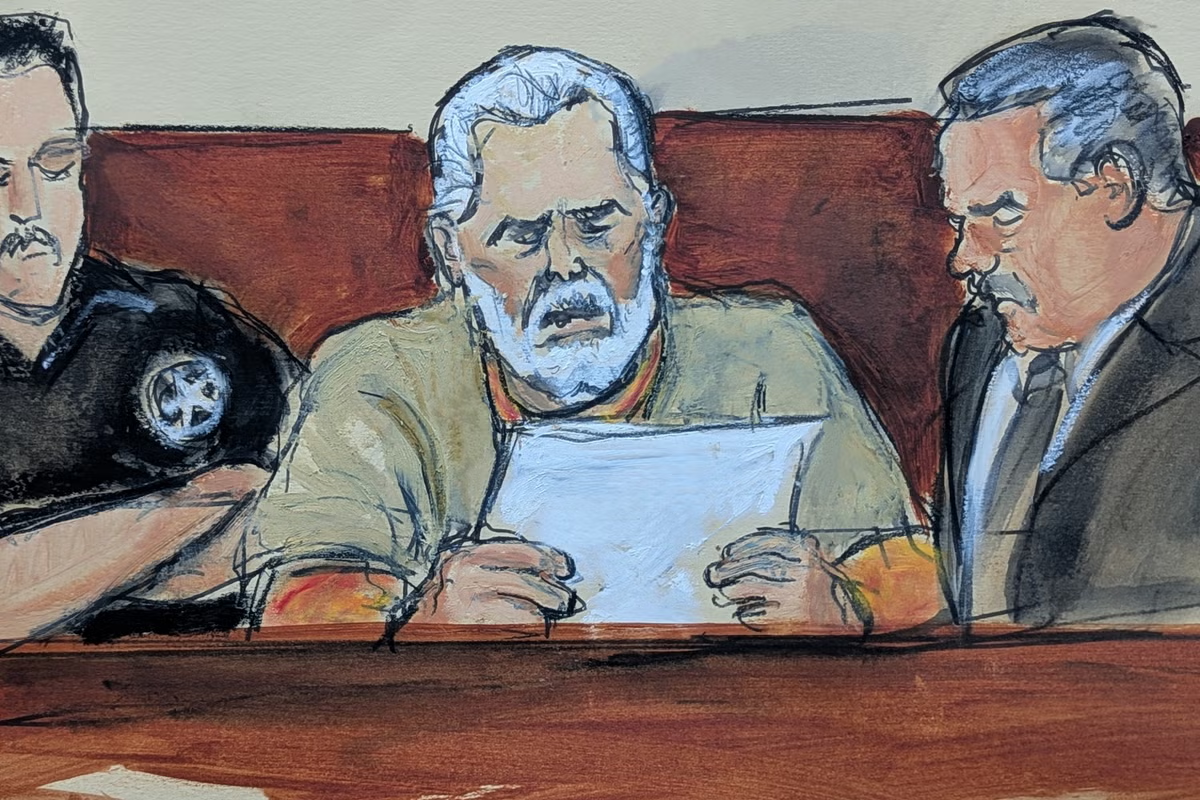
Ismael “El Mayo” Zambada, the notorious Mexican drug kingpin, was sentenced to life in a U.S. court on Monday, where he unexpectedly called for an end to the brutal violence that defined his reign over the Sinaloa cartel.
Prosecutors described the organization as the world’s largest drug trafficking enterprise.
“No one wins in a war like this,” the 76-year-old Zambada stated through a Spanish-language translator in Brooklyn federal court.
He offered an apology “for the harm I caused and for the example I set,” urging future generations to “choose a different path.”
The Sinaloa cartel co-founder emphasized, “If there’s one thing I can say that has value today, it’s this: the violence must end. In Mexico and elsewhere affected by this type of crime, too many lives are lost, too many families are destroyed, and too many young people are trapped in a cycle that leads only to prison or death.”
However, Assistant U.S. Attorney Adam Amir painted a starkly different picture, asserting that violence was Zambada’s “tool for more than three decades when it benefited him.”
Amir detailed how Zambada ordered torture and plotted murders, including the killing of his own nephew, as the cartel inundated the U.S. with tons of cocaine, fentanyl, methamphetamine, and other illicit drugs.
The prosecutor highlighted that over a million Americans died of overdoses during Zambada’s leadership, many from drugs originating in Mexico or from the Sinaloa cartel.
Zambada’s punishment was a foregone conclusion, guaranteed by his guilty plea last year to drug trafficking charges that carry a mandatory life sentence.
He also faces $15 billion in financial penalties derived from the cartel’s criminal proceeds, though prosecutors have yet to identify or recover any assets.
Judge Brian M. Cogan acknowledged the lack of judicial discretion, stating, “The sentence here is kind of anticlimactic because I have no discretion. He is going to spend the rest of his days in prison. He accepts that.”
His sentencing marks the culmination of the U.S. government’s years-long pursuit to bring the long-elusive drug lord to justice.
Zambada was arrested in 2024 after claiming he was kidnapped in Mexico and flown to Texas.
Brooklyn U.S. Attorney Joseph Nocella Jr. remarked, Zambada “spent nearly four decades poisoning American communities to make billions of dollars in profit and ordering the murders of anyone who stood in his way. Today, that chapter closes for good.”
Acting on a defense request, Judge Cogan announced he would recommend Zambada serve his sentence at a federal prison hospital to receive treatment for what his lawyer described as a “complex of age-related health issues.”
While the judge ordered Zambada’s medical records sealed, he noted the defendant suffers from a number of “progressive illnesses” and that his mental state is “drifting toward cognitively impaired.”
The final decision on placement rests with the federal Bureau of Prisons.
Zambada’s lawyer, Frank Perez, stressed in court that his client was not cooperating with prosecutors. Perez contrasted Zambada’s guilty plea with the decision of his co-founder, Joaquín “El Chapo” Guzmán, to go to trial – an 11-week ordeal that necessitated closing the Brooklyn Bridge to transport Guzmán.
Judge Cogan acknowledged that by pleading guilty, Zambada “has spared us all an exercise that we all know would’ve been very difficult.”
Wearing a tan jail suit over an orange T-shirt, Zambada walked gingerly as federal marshals escorted him.
Initially, he struggled to hear and understand the courtroom translator, requesting Cogan to speak slower, but indicated he could follow after an earpiece adjustment.
He read his remarks in Spanish from a piece of paper, coughed several times, and appeared emotionless as his sentence was confirmed.
Zambada was widely regarded as the Sinaloa cartel’s strategist and dealmaker, more deeply involved in its daily operations than Guzmán, who was convicted in 2019 and is serving a life sentence.
Zambada’s arrest in July 2024, which his lawyer claims involved being beaten and abducted by one of Guzmán’s sons, sparked deadly clashes between his loyalists and Guzmán’s sons, known as the Chapitos.
He pleaded guilty in August 2025 to charges of engaging in a continuing criminal enterprise and racketeering conspiracy, acknowledging culpability for 85 underlying crimes after prosecutors agreed not to seek the death penalty.