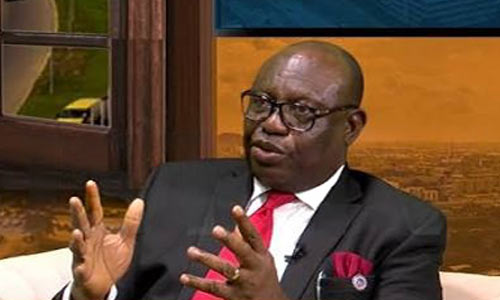
By Festus Okoye
We have established that constitutional and legal safeguards are intended to prevent electoral mischief-makers and anti-democratic forces from taking control of the federation’s government, except as provided by the Constitution.
We have also established that sovereignty belongs to the people of the Federal Republic of Nigeria, who are constitutionally and legally empowered to elect their leaders. No one should come to power except by the people’s vote.
The critical question, therefore, is how to dismantle the illegal roadblocks to genuine elections. Some can be removed before the 2027 general elections, while others may require sustained efforts as the country advances on its democratic journey. Still others may be difficult to dismantle because those who benefit from them are determined to preserve the status quo.
Incendiary and base language
Some politicians either do not understand or fail to appreciate the power of the spoken and written word. Others understand it all too well but believe they can evade the consequences of their actions. When things go wrong, they can flee to other countries where their sons and daughters, and sometimes their entire families, already live.
Unfortunately for them, the rise and growing influence of social media have shifted the dynamics. Information is now widely accessible, and anyone with a smartphone can reach a global audience. Information travels around the world almost instantly. When they flee, global information tracks their footprints.
Yet, trapped in old ways of political engagement, some politicians continue to make reckless statements and incite their followers with hate-filled, inflammatory and degrading rhetoric.
As campaigns intensify, security agencies must act decisively against incendiary language that threatens public peace and the integrity of the electoral process. Failure to address this menace could create another illegal roadblock to free, fair and credible elections.
Deodorisation of crime
Some political parties, candidates, consultants and middlemen need to become familiar with the 2026 Electoral Act. They must dismantle, or be compelled to dismantle, the illegal roadblocks they erect to undermine free and fair elections. Some seek to replace their will with that of the voters.
They want to vote on the people’s behalf, control voters’ choices and exploit poverty as bait. Yet voters are becoming more discerning even as politicians grow more sophisticated in their tactics.
In Nigeria, vote buying has evolved into a sophisticated practice. Some politicians no longer rely on winning voters’ goodwill or persuading them with policy proposals and credible programmes.
Instead, they offer money and other inducements, relying on the dubious claim that voters can accept the money and still vote according to their conscience. Security agencies must help Nigerians confront this menace, which undermines the electoral process.
Unfortunately, some security personnel are complicit, accepting inducements and turning a blind eye. Some even accept food and other items delivered to polling units for distribution as part of vote-buying schemes. Vote buying is an illegal obstacle to genuine elections and must be dismantled. Some are disguised as “empowerment”, “constituency projects” and “poverty alleviation”.
Security agencies must recognise that their constitutional duty is to protect the Nigerian people and uphold the law, not to advance the interests of the government in power or any political party.
Political parties, candidates, consultants and middlemen should pay particular attention to Section 22 of the Electoral Act, 2026.
As cited here, the provision criminalises unlawful possession, sale, attempted sale or purchase of voters’ cards, as well as the buying and selling of votes, whether on one’s own behalf or on behalf of another. Penalties include a fine of at least N5 million, imprisonment for at least two years, or both.
The provision also renders a person ineligible to stand for election in Nigeria for at least 10 years. Complaining about vote buying is not enough. In some cases, voters actively seek out those willing to buy their votes and agree to sell them.
We can speak at length about the weaponisation of poverty, but we must also confront the uncomfortable truth that some who sell their votes know the money they receive will make little or no lasting difference in their lives. They collect the money, surrender their electoral choices to vote buyers or their intermediaries, and walk away, often for the next four years.
As a result, they are poorly positioned to hold elected officials accountable. Their votes may have been sold, but their fundamental rights as citizens remain intact. No matter how it is disguised, vote buying and selling constitute illegal roadblocks to genuine elections.
Although the law prohibits these practices, parts of the political elite continue to devise ways to control voters’ choices and influence their decisions at the ballot box. Protecting electoral mandates is a shared responsibility among voters, civil society organisations and the media.
Vote buyers will have less influence if voters refuse to sell their votes. They will also find it harder to operate when communities value their electoral choices, reject inducements and hold those who attempt to manipulate elections accountable.
The regime of political thugs
Nigerians must dismantle the regime of political thuggery that has taken root around polling units. Political thugs intimidate voters, seize control of specific polling units, enforce their sponsors’ orders, and target ballot papers and ballot boxes. In some cases, they attack, maim or kill presiding and assistant presiding officers. These actions distort the electoral process and frustrate voters’ genuine expression of preference.
Unfortunately, some candidates are determined to be declared winners at all costs, believing they can handle whatever happens afterward. This attitude encourages political violence and erodes public confidence in elections. Political thugs thrive where citizens are not vigilant, organised or prepared to defend their electoral rights.
They also exploit polling units where material inducements take precedence over the freedom to make independent choices. Dismantling this illegal roadblock requires effective security measures, impartial law enforcement, vigilant citizens and the political will to hold perpetrators and their sponsors accountable. No candidate should be allowed to benefit from violence, intimidation or the destruction of electoral materials.
The survival of democracy
The survival of multiparty democracy is a collective endeavour that depends on the commitment of all key stakeholders to democratic principles and practices. Free, fair and transparent elections are inseparable from the activities that precede, accompany and follow election day.
Elections must be a festival of democracy, not a dance of death. The growth and maturity of Nigeria’s democracy will largely depend on the political class’s collective resolve to play by the rules, embrace the democratic spirit, respect the rule of law and due process, and allow the electoral management body to carry out its responsibilities.
Grandstanding and boastful declarations, often accompanied by an attitude of impunity, undermine these objectives. Statements such as “There is no vacancy in Government House,” “I will deliver my state,” “I did not give him a ticket,” “We did not want to use federal might to take the state,” and “I guarantee 2.5 million votes” signal a troubling disregard for voter independence and for the uncertainty that should characterise democratic competition. Such rhetoric can alienate young people from the democratic process and imply that little separates democratic governance from unconstitutional rule.
Elections cannot be meaningful when their outcomes are portrayed as predetermined or when political actors suggest that public office is theirs to allocate, defend or retain at will. If the political class fails to recognise the dangers of political violence and attempts to trade away the will of the people, democracy could be imperilled, with grave consequences for Nigeria, West Africa and the African continent.
The electoral management body, for its part, must demonstrate competence, independence, courage, professionalism and the highest ethical standards in conducting elections. It must enforce the rules without fear or favour, placing the interests of the Nigerian people above partisan interests.
Yielding to pressure from forces hostile to democratic principles would have disastrous consequences. Security agencies must recognise that their constitutional duty is to protect the Nigerian people and uphold the law, not to advance the interests of the government in power or any political party.
They must perform their electoral duties impartially and professionally, ensuring equal treatment for all political actors. Civil society organisations must do more than observe elections. They must mobilise citizens, raise public awareness and work collectively to defend Nigeria’s democracy against threats posed by anti-democratic forces.
When election results are fiercely contested, such forces may exploit the resulting uncertainty to advance their agendas. Vigilance, civic engagement and respect for lawful dispute-resolution mechanisms are therefore essential.
Ultimately, Nigeria must dismantle illegal roadblocks that impede genuine elections. Safeguarding Nigeria’s democracy is everyone’s responsibility.
The 2027 general elections must offer an opportunity to strengthen democratic institutions, restore public confidence and reaffirm the fundamental principle that political power belongs to the people and must be acquired and exercised in accordance with the Constitution and the law.
The post Safeguards And Roadblocks To Nigeria’s 2027 Elections [3] appeared first on TheNigeriaLawyer.

