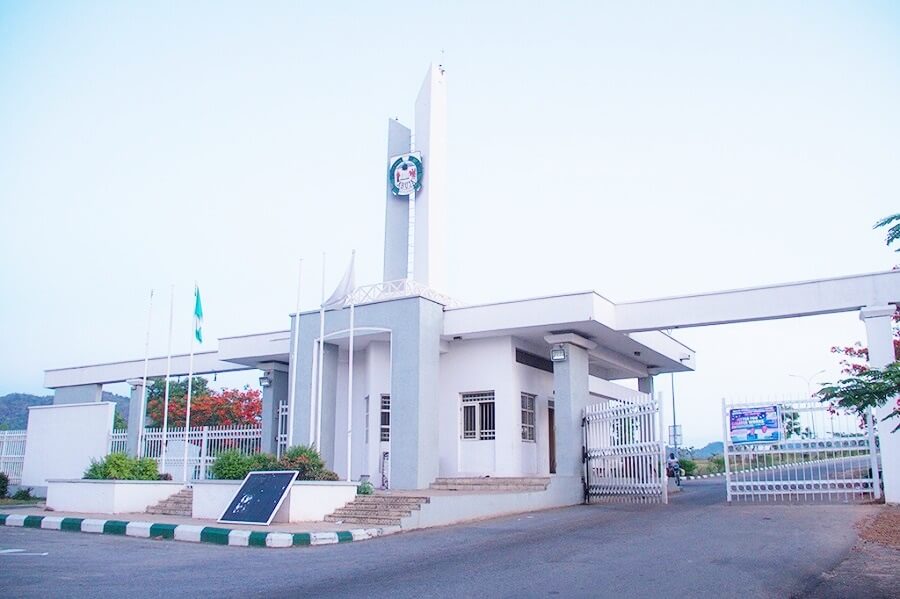
The administration said the decision, which has triggered protests by the university community, was based on findings that its original land allocation exceeded the size recommended by the National Universities Commission (NUC).
In a statement on Monday, the Minister’s Senior Special Assistant on Public Communications and Social Media, Lere Olayinka, described the protest by the university’s Joint Action Committee (JAC) as misplaced.
He argued that the current FCT Minister, Nyesom Wike, had allocated more land to the institution than the 100 hectares recommended by the committee.
The protest was organised by members of the Academic Staff Union of Universities (ASUU), Senior Staff Association of Nigerian Universities (SSANU), Non-Academic Staff Union of Educational and Associated Institutions (NASU), Students’ Union Government (SUG) and the university’s alumni association.
Olayinka questioned the university’s need to retain more than 11,000 hectares after 38 years of establishment, arguing that large portions of the land remained undeveloped.
He said the committee, inaugurated on November 10, 2016, was constituted to examine the university’s land allocation, encroachment by indigenous settlers, illegal developments on its Gwagwalada Mini Campus and the issuance of land titles for its two campuses.
According to him, the 12-member committee included five representatives of the university: Prof. Otaki Alanana, Prof. A. Mallam, Mohamed Kassim, A.E. Ripite and Sadiq O. Shuaibu.
Olayinka said the committee found that the university’s main campus, covering more than 11,000 hectares, was far larger than the size recommended by the NUC and consequently proposed an allocation of 100 hectares.
He said the report was approved by Bello before Wike assumed office, adding that the current minister subsequently approved 4,519.80 hectares for the university, bringing its total allocation to 4,685 hectares.
The minister’s aide argued that the revised allocation was sufficient for the institution’s development, claiming that it could accommodate more than 80,000 buildings, based on a plot size of 500 square metres.
He also questioned whether the university’s representatives on the 2016 committee had informed the unions and other stakeholders about its recommendations.
Olayinka challenged the protesters to identify universities elsewhere in the world occupying more than 11,000 hectares and explain why the University of Abuja required such an extensive land area.
He further alleged that the university had allocated portions of its land to individuals and corporate organisations, including the Economic and Financial Crimes Commission (EFCC), without obtaining approval from the FCTA.
He claimed that the institution allocated 100 hectares to the EFCC without recourse to the FCTA.
“If the government that owns a university chooses to reduce the size of its land on which no structure has been built in the school’s 38 years of existence, what effect will that have on ASUU, SSANU and NASU? Will that affect the payment of their salaries? Will it affect the students in terms of their studies?” he asked.
He urged the university’s staff unions to explain what he described as their real interests in the dispute over the institution’s land allocation.