Journalism, like the harmattan wind, first toughens the skin before it tempers the soul….
Journalism, like the harmattan wind, first toughens the skin before it tempers the soul.
For over a decade, I have walked its long, winding corridors, sometimes lit, often dim, serving through Radio Nigeria Peace FM, Kanem FM, SMK Radio, the Nigerian Television Authority, and now TVC News.
The profession has taken me across difficult terrains where fear speaks in hushed tones, uncertainty lingers like an uninvited guest, and courage is not a choice but a daily obligation.
Along this path, I have grown, shaped by discipline, sacrifice, and an unwavering commitment to truth.
In that journey, I have encountered power in many forms.
I have stood before men whose titles echo loudly and whose presence commands attention.
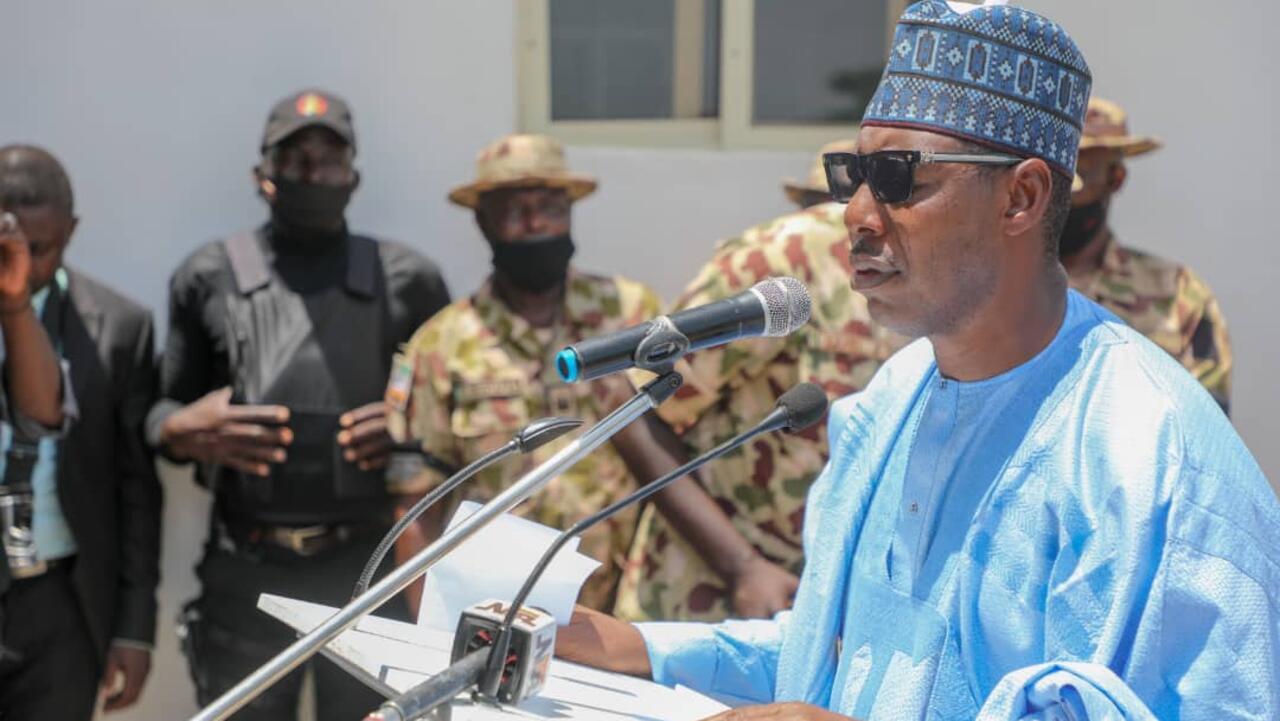
But among them all, one man stands apart, not by the noise of authority, but by the quiet gravity of his character: Professor Babagana Umara Zulum.
Governor Zulum is humility in motion.
His kindness often arrives before his words, his vision stretches beyond what the eyes can see, and his courage meets danger without flinching.
Tenacity walks beside him like a trusted ally, while sacrifice seems stitched into the very fabric of his being.
As a young journalist covering assignments at the Government House, I was simply doing my job, observing, reporting and moving on.
Unknown to me, somewhere within those walls, the governor was paying attention.
Then, one day in February 2021, after a function at the Council Chambers, he called me by name:
“Jesse Tafida, you are doing a great job. Keep it up.”
In that moment, time paused, surprise gripped me, and my thoughts scattered like startled birds.
How did the Executive Governor know my name? How closely does he watch?
But beyond the astonishment, those words did something deeper, they planted a seed.
From that day, my dedication found new meaning.
Journalism ceased to be merely a profession but became a responsibility, one I owed to excellence.
Life, however, has a way of testing strength.
That same year, I lost my father and even from a distance, Governor Zulum reached out, offering condolences that felt sincere, not ceremonial.
Power, in that moment, stepped down from its pedestal and spoke the language of empathy.
In 2022, as I prepared for my wedding, his support helped shape a memorable day.
But soon after, tragedy struck again. Just two weeks into marriage, I lost my wife.
While on pilgrimage, the governor heard the news and immediately sent a government delegation to console me.
Later, when I lost my mother, he came in person, accompanied by members of his cabinet to my modest home.
Authority followed him, but compassion led the way.
Since then, his encouragement has been steady, like a river that refuses to run dry.
He always reminds me to stay strong, to keep pushing, to remain focused.
His simplicity quietly dismantles the distance that often separates leadership from the people.
One experience remains deeply etched in memory.
During an end-of-year tour to Mallam-Fatori in December 2025, far in the troubled fringes of northern Borno, comfort seemed to disappear into the wind.
There, Governor Zulum slept in a modest zinc shelter, the cold biting through the night, dust settling stubbornly on every surface, and mosquitoes asserting their presence without restraint.
Commissioners and aides shared the same harsh reality with no privilege and no exception.
Mallam-Fatori itself is no ordinary town. It has long stood as a red zone, its soil familiar with the echoes of gunfire and the weight of sacrifice.
A place fiercely contested by insurgents, where brave soldiers have fought relentlessly to defend Nigeria’s territorial integrity.
It is also a place where an army commander paid the ultimate price, laying down his life in service to the nation.
Yet, it was in this same volatile ground that Governor Zulum chose to spend his nights, unmoved by the risks, undeterred by the dangers.
While fear lingered in the air like an unspoken warning, he remained present, calm, and resolute, standing not above the people, but firmly among them.
Who does that?
Professor Babagana Zulum.
He strips power of excess and clothes it in sacrifice.
Like a father who chooses discomfort so his children may find relief, he walks among displaced communities not as a distant figure, but as one who understands their pain.
Hope listens when he speaks. Fear retreats at his approach. And communities, long burdened by hardship, begin to stand a little taller.
I have watched him speak to widows, his words soft yet steady, his eyes carrying the weight of shared understanding. I have seen displaced persons draw strength from his assurances, as though leaning on something firm and unbreakable.
On dangerous roads, where uncertainty prowls like a restless shadow, he remains composed, focused, resolute, unshaken.
This is not mere praise, but testimony. A reflection from a journalist who has watched, listened, and followed closely.
Governor Zulum teaches without a classroom, mentors without formality, and leads without noise.
His life itself is a quiet, powerful lecture on service.
Many will say we have a governor.
But I say, with firm conviction, we have a leader.
Babagana Umara Zulum is integrity in motion, sacrifice made visible, and leadership given a human face, a rare embodiment of purpose in a time that yearns for substance over mere ceremony.