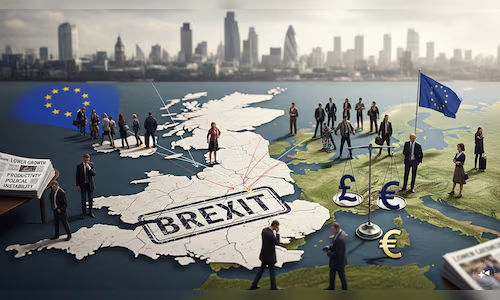
On June 23, 2016, the UK voted 52% to 48% to leave the EU, ending more than four decades of membership in the bloc. The result triggered sharp market volatility, sent the pound tumbling and ushered in a prolonged period of political uncertainty that has seen six prime ministers resign in the decade since the referendum.
While Britain formally left the EU in 2020, economists argue that the economic effects of Brexit continue to shape the country’s growth trajectory.
Growth and productivity have taken a hit
The UK’s Office for Budget Responsibility (OBR) estimates that the post-Brexit trading relationship will reduce Britain’s long-run productivity by 4% compared with remaining in the EU.
The fiscal watchdog also expects UK exports and imports with the EU to be around 15% lower over the long term than they would otherwise have been, while trade deals with non-EU countries are unlikely to materially offset the impact.
Other studies suggest a higher economic cost. Bloomberg Economics estimates Brexit may have reduced Britain’s long-run economic output by around 2.5% of GDP, equivalent to roughly £30 billion in annual tax revenue.
Research published through the US National Bureau of Economic Research estimated that Brexit reduced UK GDP by between 6% and 8% by 2025, while lowering productivity and employment by 3%-4% and reducing investment by 12%-18%. The researchers attributed the weakness to increased uncertainty, lower expected demand and weaker productivity growth.
Not all economists agree. Julian Jessop of the Institute of Economic Affairs has argued that some estimates overstate Brexit’s impact by comparing Britain’s performance with unusually strong US growth and that UK GDP per capita growth has been broadly comparable to France and Germany.
Trade remains tied to Europe
Despite years of efforts to deepen trade relationships elsewhere, the European Union remains Britain’s largest trading partner.
In 2025, the EU accounted for 41% of UK exports and 50% of imports, underlining the continued importance of the bloc to British businesses.
Many exporters have reported higher administrative costs since Brexit, including customs declarations, compliance requirements and border paperwork.
Economists at the National Institute of Economic and Social Research estimate Brexit reduced GDP per capita and labour productivity by 2%-3% by 2023 and could widen to 5%-6% by 2035.
The pound never fully recovered
One of the most visible economic consequences of Brexit has been sterling’s decline.
The pound plunged after the referendum and remains below its pre-Brexit levels against both the euro and the dollar.
Goldman Sachs estimates that Brexit reduced sterling’s fair value by around 6%. Although the currency has recovered significantly since Britain formally left the EU, it remains roughly 10% below its pre-referendum level against the dollar.
The weaker currency has increased the cost of imported goods, energy and raw materials for British consumers and businesses.
London’s financial sector proved resilient — but lost ground
Before the referendum, several financial institutions warned that Brexit could undermine London’s status as Europe’s leading financial centre.
The outcome has been more mixed.
According to estimates from the City of London Corporation, around 40,000 financial-services jobs were relocated to EU hubs after British firms lost passporting rights that previously allowed them to serve clients across the bloc.
Britain has also lost market share in 10 of 12 major international finance categories since 2015, including foreign-exchange trading, stock listings and assets under management, according to research firm New Financial.
Yet London’s financial sector remains one of the world’s largest. Employment in the City of London is near record highs, while major institutions, including JPMorgan and Citigroup, continue to expand their UK operations.
Britain remains the world’s second-largest destination for foreign capital after the United States, hosting more than £12 trillion in foreign direct investment, portfolio investment and cross-border deposits at the end of 2025.
Immigration changed, but not as expected
Immigration was one of the defining issues of the Brexit campaign, with supporters arguing that leaving the EU would allow Britain to regain control of its borders.
While migration from EU countries has fallen sharply since Brexit and turned negative in 2022, migration from non-EU countries increased significantly in subsequent years, driven by labour shortages, international students and humanitarian visa programmes.
The result has been a shift in the composition of migration rather than an outright reduction in overall inflows.
A political debate that never ended
Brexit was intended by then-Prime Minister David Cameron to settle Britain’s long-running debate over Europe.
Instead, it reshaped the country’s political landscape.
The referendum triggered years of parliamentary deadlock, contributed to the rise of populist politics and redrew traditional party loyalties. Since the vote, Britain has cycled through six prime ministers, underscoring the political instability that followed the referendum.
A decade on, the debate remains unresolved. Polling conducted by Ipsos for Bloomberg found that 52% of British adults would now vote to rejoin the European Union if another referendum were held.
For supporters, Brexit delivered greater political sovereignty and regulatory independence. For critics, it has imposed lasting costs on growth, trade and investment.
Ten years after the referendum, economists continue to debate the precise scale of the economic damage. What is less disputed is that Brexit fundamentally altered the trajectory of the British economy and politics, and its effects continue to be felt across both.