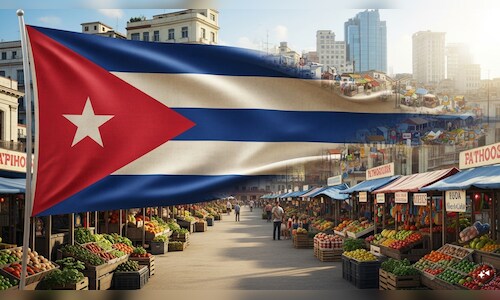
The 176 measures aim to further decentralise Cuba’s state-run economy, which has been left gasping by a tightened embargo under President Donald Trump. Under the island’s current economic model, the government largely determines what is produced, who produces it, the prices at which goods are sold and how the country’s resources are allocated.
The plan includes more space for private businesses, imports and exports without state intermediation, free hiring of personnel, authorisation for private banks and investment by Cubans abroad. It even permits fast-food chains to establish themselves on the island.
“Elements that for decades were listed as pillars of the revolutionary economy, such as the state monopoly on foreign trade and the centralisation of productive forces, have been dismantled,” said Luis Carlos Battista, a Cuban American political scientist and lawyer who is a doctoral candidate at the University of Salamanca.
Cuban leaders like former President Raúl Castro – who still wields significant power on the island – have sought to push forward more limited reforms of Cuba’s economy in the past, but efforts have run into bureaucratic hurdles. In passing the reform, Cuban authorities cautioned that implementation could be slow, and noted measures will not be viable if the US does not lift the energy and financial embargo on the island.
Since January, Cuba has been under a harsh energy and financial embargo imposed by the US, effectively blocking Cuba off from fuel, its main energy source, and deepening the crisis had already been deteriorating for the past five years. Blackouts have lasted up to 20 hours a day and have restricted access to health services, transportation and education.
US President Donald Trump and Secretary of State Marco Rubio acknowledged that they are maintaining a policy of maximum pressure to change the island’s political and economic system, which has endured for six decades despite US pressure. They have not ruled out the use of military force.
In an interview published Friday, in the United Arab Emirates-based The National, Raul Guillermo Rodriguez Castro, grandson of the revolutionary leader, reiterated that Cuba “doesn’t even slightly represent a threat” to the US.
Rodriguez Castro said in the video interview that Cuba’s government was seeking a “very Cuban” economic model.
“Our country must seek a path to economic development where we must inevitably diversify our economy, diversify the way we do business and diversify the way we do investments,” he said.
Cuban President Miguel Díaz-Canel said that the proposed measures were based on an analysis of the Vietnamese and Chinese models, communist countries with market economies.
What is likely to pose a significant barrier are US sanctions on Cuba, said Lee Schlenker, a research associate at the Quincy Institute in Washington.
“With these new measures, along with others that are likely on the table, they will only have a true effect if complemented with the gradual lifting of US prohibitions and sanctions more broadly,” he said.
Without sanctions being lifted, Schlenker and other analysts said many of the presented measures will be inapplicable, especially due to the limitations and prohibitions imposed on potential investors, who are penalised in the US financial system if they do business with Cuba.
Beyond that, there are a number of other obstacles that could stymie significant reforms, ranging from mistrust from potential investors to what Battista, the Cuban American analyst called “slow and inefficient” bureaucracy.
Despite these obstacles, the Cuban government faces a short window for obtaining results, said Paolo Spadoni, associate professor in the Department of Social Sciences at Augusta University in Georgia.
“If Cuban leaders hope to survive this unprecedented crisis and the pressure from the United States, they must move quickly with the implementation of reform and the achievement of tangible results,” Spadoni said.