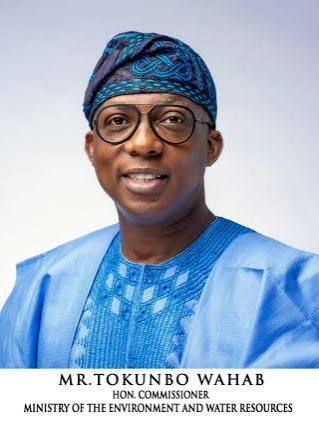
He is also an alumnus of Harvard Kennedy School, Harvard Business School and the Wharton School of the University of Pennsylvania. Wahab began his legal career at Jiti Ogunye & Co. Associates before working at Paul Usoro & Co. and Aluko & Oyebode. In 2009, he founded Wall & Ace Legal Practitioners, where he served as Managing Partner until 2019.
His public service career began in 2019 when he was appointed Special Adviser on Education to the Lagos State Governor, a position he held until 2023. He was subsequently appointed Commissioner for the Environment and Water Resources.
In this no-hold-barred interview with THERESA MOSES & OLUWATOSIN SIMON FALEYE, Wahab speaks on the environmental challenges confronting Lagos and the government’s response. He addresses the limits of flood control in a coastal megacity, demolitions and allegations of selective enforcement, waste management reforms, plastic pollution, extreme heat and the persistent challenge of public water supply. He also explains the rationale behind the government’s environmental enforcement policies; responds to concerns about access to water and reflects on the legacy he hopes to leave behind.
Q: You recently said Lagos has achieved between 75 and 80 per cent success in flood abatement, with a target of 90 per cent by 2027. Considering that about one-third of Lagos is covered by water and some areas are below sea level, how does the government intend to move from 80 to 90 per cent? And is zero flooding truly impossible in Lagos?
Wahab: If we are conversant with global developments, some days ago, the city of Georgia experienced heavy flooding. Around September this year, New York and New Jersey also experienced serious flooding for days.
Lagos is a state with about 3,530 square kilometres of land, representing approximately 0.4 per cent of Nigeria’s landmass, but it accommodates about 10 per cent of the country’s population. One-third of Lagos’s landmass is water. Along our southern border, we share about 186 kilometres with the Atlantic Ocean. In between, we have creeks, lagoons and rivers. Realistically, there is no way you can stop flooding 100 per cent in Lagos because of our geography and climate-related challenges.
Lagos is exposed to excessive heat, excessive rainfall and rising sea levels. When these factors combine, flash flooding occurs. Sometimes, the water takes an hour or two to recede. That is why we advise residents to remain patient and avoid taking unnecessary risks during heavy rainfall. Once the rain stops and the water level drops, the storm water can discharge downstream.
Some parts of Lagos are below sea level. What we have done differently is to provide infrastructure that protects those areas. Lagos Island, for instance, is below sea level. We decided that the drainage infrastructure there should come with a pump station.
We installed a pump station at Ilubirin, which is designed to discharge millions of gallons of water every hour. Conventional drainage infrastructure alone would not have achieved the same result as effectively because of the area’s elevation. We are also making provisions for areas such as Kusenla, where reclamation and other activities have affected the natural movement of water. A pump station is planned there to discharge storm water into the lagoon during heavy rainfall.
Another major intervention is the Emergency Flood Abatement Gang (EFAG). About three years ago, we transitioned its operations from seasonal work to an all-year-round arrangement, enabling members to work throughout the year to clear and desilt drainage channels. We have also improved their welfare through the provision of health insurance under Ilera Eko, a social health insurance scheme managed by the Lagos State Health Management Agency (LASHMA), as well as improved wages and hazard allowances.
Our position is that if we get the evacuation of water and drainage channels right, we can address a significant percentage of our flooding challenges. We have also intervened where people encroached on drainage systems and floodplains. In some places, structures had to be removed to protect the natural flow of water. We are also protecting drainage rights of way and installing infrastructure to reduce the risk of flooding. So, while we are working towards significant improvements, achieving zero flooding in Lagos is not realistic because of the state’s geography and climate-related challenges.
Q: You recently inspected Odo Iya Alaro (Opebi Link Bridge), Modupe Johnson Crescent, off Adeniran Ogunsanya, Surulere, and Osborne Foreshore Phase II, (Ikoyi) over drainage encroachment. Lagosians complain that enforcement is selective that powerful estates get a pass while small traders get demolished. How do you respond to that?
Wahab: Some months ago, I had a friend who built an estate around Ikota. He built 52 houses, and 47 of them were on the alignment of the Ikota River. We had to remove those structures. He is my friend. He comes to my house and eats in my house. I have attended his children’s weddings and graduation ceremonies outside the country. That tells you the kind of relationship we have. But overriding public interest takes precedence over personal relationships. Public service is not meant to be a walk in the park. You have to make tough decisions if you want to do the right thing. I do not owe anybody an apology for doing what is right.
When people say we are selective, I laugh. This ministry does not discriminate based on colour, tribe or religion. I have challenged people who claim they have approvals to bring them forward. If you have approval, bring it out. We will establish who approved it and under what conditions. Before building, there are requirements. You must have the necessary planning approvals, environmental impact assessment where applicable and other relevant clearances. You must demonstrate that your development will not obstruct storm water movement or create flooding risks.
Being educated, wealthy or influential does not put anybody above the law. Some of the people you think should know better are usually the ones who violate the laws of the state. We have encountered people who have been building in Lagos for years without applying for the necessary government documents. There are processes for obtaining approvals, and the relevant agencies have records of applications and developments. Some approvals are also subject to environmental clearance, which developers must obtain before proceeding.
We should not encourage a situation where people build first and expect the government to look away. If you build on a floodplain, you are putting lives at risk. The reason some developed countries are able to maintain order is that there are consequences for wrongdoing. We cannot continue to expect development while allowing people to violate the law without consequences. I have more enemies than friends because of some of the decisions I have taken. I do not mind that. I left a very good legal practice to come into public service. I want to do the work well.
Q: Lagos generates between 13,000 and 15,000 tonnes of waste daily. In May 2026 alone, 418,500 tonnes were reportedly evacuated, yet refuse continues to pile up in several areas. The government has also made changes to the leadership of LAWMA. What went wrong, and what will the new leadership do differently?
Wahab: To start with, I do not run LAWMA. There are eight agencies under the ministry, and LAWMA is just one of them. These include the Lagos State Environmental Protection Agency (LASEPA), Lagos State Waste Management Authority (LAWMA), Lagos State Parks and Gardens Agency (LASPARK), Lagos Water Corporation (LWC), Lagos State Water Regulatory Commission (LSWRC), Lagos State Signage and Advertisement Agency (LASAA), Lagos State Environmental Sanitation Corps (LAGESC/KAI), and Lagos State Wastewater Management Office (LSWMO). Our responsibility is to set the policy direction. The state’s policy is to transition from the linear system of collecting and dumping waste to a system in which waste becomes a resource for wealth creation and energy generation.
Between February and that period, we noticed that there were systemic challenges involving LAWMA and the Private Sector Participation (PSP) operators. The PSP operators are private businesses providing waste collection services. They had challenges, and LAWMA, as the regulator, had to intervene to support them in evacuating waste. We gave them certain responsibilities, but they struggled to meet some of the expectations. The government had to review the situation and make the necessary management decisions. The new leadership will be expected to work within the policy direction and deliver on the responsibilities assigned to it. The governor appointed the officials, and they are expected to meet the targets set for them.
Q: Olusosun has reached its operational limit and you’ve just upgraded Solous III in Igando to serve Lagos West. What is the long-term plan? Is Lagos finally moving from dumpsites to real waste-to-energy and recycling?
Wahab: The truth is that we cannot sustain the pick-and-dump system. It is no longer the model we want to maintain. However, you need political will to make that transition, and we have demonstrated that commitment. We did not begin with waste-to-energy alone. We started by banning styrofoam, which contains substances of environmental and health concern and is non-biodegradable. The ban was informed by a report commissioned from the United Nations Environment Programme. We also banned certain single-use plastics. These were steps towards changing the way we manage waste.
We have introduced food-waste-to-energy initiatives at food markets. We are also developing transfer stations and other facilities to support the transition. There are facilities being developed to process waste and recover useful materials. The intention is to expand these operations and make them sustainable. We are also bringing in 150 trucks to complement the 102 trucks available to LAWMA. The long-term plan is to decommission and cap existing dump sites. But before doing that, we must ensure that alternative facilities are fully operational. We cannot shut down existing arrangements without having sufficient capacity to handle the waste generated daily. The PSP operators are also an important part of the system. We must strengthen the entire waste-management chain, from collection to transportation, processing and final disposal.
Q: Lagos has intensified enforcement against styrofoam and single-use plastics. How well are residents, traders and businesses complying? Does the government have figures to show the level of compliance?
Wahab: We have not achieved 100 per cent compliance, but we have crossed 70 per cent. There was a month when compliance was around 80 per cent. I can obtain the data from the relevant department in the Ministry of the Environment. What we have also done differently is to strengthen advocacy. We have engaged market leaders and brought them into the process. We are combining enforcement with public education. Some of the companies producing these materials are not based in Lagos. They operate in neighbouring states. Thankfully, they have seen that we are serious and are beginning to transition to alternative materials that are biodegradable. There are recycling businesses in neighbouring states that can also benefit from the materials generated in Lagos. That is the kind of transition we want. If we manage waste properly and reduce the amount of plastic entering our drainage channels, we will also reduce some of the problems associated with flooding.
Q: On October 30, you warned about extreme heat and its impact, particularly on children, pregnant women and outdoor workers. Lagos is densely populated and getting hotter. Beyond public warnings, what concrete infrastructure is the state putting in place to improve heat resilience?
Wahab: We encourage people to go green. That is why we have the Lagos State Parks and Gardens Agency (LASPARK). People should plant flowers and trees and preserve green spaces. Do not turn every available space into concrete. In the past, people bought land and wanted to build on every part of it, leaving no room for gardens or greenery. What do you expect in such an environment? Green spaces help to absorb heat and improve the environment. But people do not always want to hear that. Someone buys land and wants to develop every square metre. The advice we gave was to guide residents because the heat conditions have been unusual. People should take enough water to remain hydrated, particularly those who work outdoors. We must also encourage people to maintain greenery around their homes. We need public support and advocacy to change the way people approach the environment.